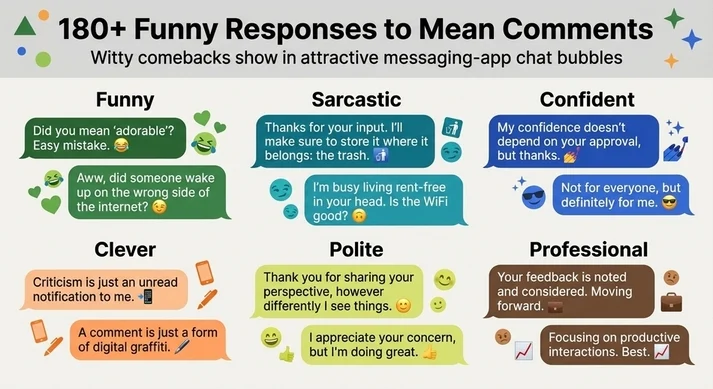
The best funny responses to mean comments are witty, confident, and lighthearted without making you look bothered. Whether someone is insulting your appearance, personality, choices, or social media posts, the right comeback can turn an awkward moment into a memorable one.
Top alternatives: “Did that make you feel better?”, “Thanks for your unsolicited review!”, “I’ll add that to my list of things I didn’t ask for.”, “Your opinion has been noted and ignored.”, “Was that supposed to hurt my feelings?”
Ever received a mean comment that left you thinking of the perfect comeback three hours later? We’ve all been there! Whether someone throws shade in your Instagram comments, makes an unnecessary remark at work, teases you in a group chat, or tries to embarrass you in front of friends, dealing with negativity can be frustrating. Sometimes, ignoring the comment is the smartest move. Other times, a little humor can turn the entire situation around. That’s where funny responses to mean comments come in handy. A clever comeback lets you stand up for yourself without getting dragged into an unnecessary argument.
From playful one-liners to witty remarks and confident replies, these responses help you handle negativity while keeping your personality intact. After all, you don’t have to lose your smile just because someone forgot their manners!
1. Funny Responses to Mean Comments
Sometimes, the best way to handle an unnecessary remark is with humor. These funny responses keep things light while showing that you aren’t easily bothered.
- “Did you rehearse that, or was it naturally disappointing?”Example: Use it when someone delivers an especially weak insult.Meaning: You are making fun of how unimpressive their comment sounds.
- “Thanks for the free comedy show!”Example: Try it when someone makes a ridiculous personal remark.Meaning: You find their negativity more amusing than offensive.
- “I’ll pretend that made sense.”Example: Use it after hearing a completely unnecessary criticism.Meaning: You are playfully dismissing their comment.
- “Was that your best material?”Example: Say it when someone tries to roast you.Meaning: You expected a much better attempt.
- “My feelings just filed a complaint against your delivery.”Example: Use it when a friend makes a poorly timed joke.Meaning: You are responding with exaggerated humor.
- “Congratulations, you’ve unlocked the unnecessary opinion achievement!”Example: Try it when someone comments on something that doesn’t concern them.Meaning: Their opinion was unsolicited and unnecessary.
- “I’m laughing because crying would ruin my makeup.”Example: Use it when someone makes a ridiculous remark about you.Meaning: You are choosing humor instead of showing frustration.
- “That comment needs a little quality control.”Example: Say it when someone makes an embarrassing observation.Meaning: Their remark could have been better thought out.
- “Should I laugh now or wait for the punchline?”Example: Use it when someone thinks their insult is hilarious.Meaning: You are questioning how funny they actually are.
- “Your negativity arrived before your manners.”Example: Try it when someone speaks rudely without considering your feelings.Meaning: You are highlighting their lack of courtesy humorously.
- “Well, that was an interesting use of your free time.”Example: Use it when someone spends time criticizing your choices.Meaning: Their unnecessary comment seems like a waste of effort.
- “I’ll give that insult two stars for creativity.”Example: Say it when someone attempts a basic roast.Meaning: You are playfully rating their weak comeback.
2. Brutal Yet Witty Responses to Mean Comments
When someone repeatedly crosses the line, a sharper response can make your boundaries clear. These comebacks deliver confidence without relying on personal attacks.
- “Your opinion isn’t as important as you think.”Example: Use it when someone acts like their judgment defines you.Meaning: You refuse to give their opinion unnecessary importance.
- “I would explain myself, but I don’t owe you a presentation.”Example: Try it when someone demands explanations about your choices.Meaning: You are standing firm without defending everything you do.
- “Being loud doesn’t make you right.”Example: Use it when someone raises their voice while criticizing you.Meaning: Confidence and volume cannot replace a valid argument.
- “Your approval was never part of my plan.”Example: Say it when someone disapproves of your lifestyle.Meaning: You are comfortable making your own decisions.
- “I don’t take criticism from people I wouldn’t ask for advice.”Example: Use it when someone offers judgment without being helpful.Meaning: You choose whose opinions deserve your attention.
- “You seem unusually invested in my life.”Example: Try it when someone constantly comments on your personal decisions.Meaning: You are pointing out their unnecessary involvement.
- “Not every thought deserves an audience.”Example: Use it when someone makes a rude remark publicly.Meaning: You believe some opinions are better left unsaid.
- “I’m not here to meet your expectations.”Example: Say it when someone criticizes how you live.Meaning: You prioritize your own goals over their approval.
- “That’s a lot of confidence for such an unnecessary comment.”Example: Try it when someone delivers an uninvited opinion.Meaning: You are questioning their reason for speaking negatively.
- “I know my worth, so your comment changes nothing.”Example: Use it when someone tries to make you feel inferior.Meaning: Your self-respect doesn’t depend on their judgment.
- “You can keep your opinion. I have enough already.”Example: Say it when someone insists on criticizing you.Meaning: You aren’t interested in accepting their negativity.
- “I’m not responsible for your inability to be respectful.”Example: Use it when someone repeatedly speaks disrespectfully.Meaning: You are making their behavior their responsibility.
3. Sarcastic Responses to Mean Comments
A little sarcasm can communicate that you aren’t impressed. These responses are ideal for situations where a playful but pointed comeback fits.
- “Oh, thank you for that groundbreaking observation!”Example: Use it when someone points out something obvious just to criticize you.Meaning: You are sarcastically questioning the value of their remark.
- “I’ll make sure to lose sleep over that.”Example: Try it when someone makes a minor personal criticism.Meaning: Their opinion isn’t worth worrying about.
- “What would I do without your negativity?”Example: Use it when someone constantly finds something wrong.Meaning: You are sarcastically highlighting their pessimistic attitude.
- “Your feedback has been forwarded to absolutely nobody.”Example: Say it when someone offers an unwanted review.Meaning: You have no intention of taking their comment seriously.
- “Wow, did you come up with that all by yourself?”Example: Use it when someone makes a predictable insult.Meaning: You are teasing their lack of originality.
- “I’ll add that to my collection of irrelevant opinions.”Example: Try it when someone criticizes your appearance or decisions.Meaning: Their judgment doesn’t influence you.
- “Such kindness! I’m truly overwhelmed.”Example: Use it after someone delivers a particularly rude remark.Meaning: You are sarcastically pointing out their lack of kindness.
- “I didn’t know we were reviewing my life today.”Example: Say it when someone starts criticizing your personal choices.Meaning: You didn’t invite them to evaluate your life.
- “Thank you, Professor of Unnecessary Comments.”Example: Try it when someone acts like an expert on your decisions.Meaning: You are making fun of their unsolicited advice.
- “I’ll consider that when I run out of better things to do.”Example: Use it when someone gives unhelpful criticism.Meaning: Their opinion isn’t currently a priority.
- “And here I was having such a peaceful day!”Example: Say it when someone suddenly introduces negativity.Meaning: You are highlighting how unnecessary their comment was.
- “Did your manners take the day off?”Example: Use it when someone makes a disrespectful remark.Meaning: You are sarcastically calling attention to their behavior.
4. Classy and Polite Responses to Mean Comments
Not every situation deserves a sharp comeback. Sometimes, a calm and respectful answer makes a stronger impression than an argument.
- “That’s an interesting perspective, but I see things differently.”Example: Use it when someone criticizes your personal choices.Meaning: You disagree without becoming disrespectful.
- “I appreciate your honesty, but kindness matters too.”Example: Try it when someone hides an insult behind honesty.Meaning: You value respectful communication.
- “Let’s keep the conversation respectful.”Example: Use it when someone starts making personal remarks.Meaning: You are establishing a clear boundary.
- “You’re entitled to your opinion, and I’m entitled to mine.”Example: Say it during a disagreement about personal decisions.Meaning: You respect differences without surrendering your viewpoint.
- “I don’t think that comment was necessary.”Example: Use it when someone makes an inappropriate joke.Meaning: You are calmly addressing their behavior.
- “We can disagree without being unkind.”Example: Try it during a heated discussion with someone you know.Meaning: You encourage respectful disagreement.
- “I’ll take the constructive part, if there is one.”Example: Use it when someone delivers criticism without offering solutions.Meaning: You are open to useful feedback but not unnecessary negativity.
- “Let’s focus on something more positive.”Example: Say it when a conversation becomes unnecessarily negative.Meaning: You want to move away from unpleasant remarks.
- “I understand your point, but I don’t agree.”Example: Use it when someone questions your decisions.Meaning: You acknowledge their perspective while maintaining your position.
- “There’s no need to make this personal.”Example: Try it when a disagreement turns into personal criticism.Meaning: You want to keep the discussion respectful.
- “I’m comfortable with who I am, thank you.”Example: Use it when someone criticizes your personality or appearance.Meaning: You demonstrate self-acceptance.
- “I hope you find a kinder way to express that.”Example: Say it when someone speaks harshly without reason.Meaning: You encourage better communication without insulting them.
5. Confident Responses to Mean Comments
Confidence is about knowing yourself without needing constant approval. These replies help you stand your ground when someone tries to make you question your value.
- “I’m perfectly happy being myself.”Example: Use it when someone criticizes your personality.Meaning: You accept yourself without seeking their permission.
- “I know who I am, and that’s enough.”Example: Try it when someone makes assumptions about you.Meaning: You don’t let other people’s judgments define your identity.
- “I don’t need everyone to understand me.”Example: Use it when someone questions your choices.Meaning: You are comfortable being different.
- “My confidence isn’t up for discussion.”Example: Say it when someone repeatedly tries to undermine your self-esteem.Meaning: You refuse to let negativity affect your confidence.
- “I’m too busy growing to worry about your comments.”Example: Use it when someone mocks your ambitions.Meaning: You prioritize personal growth over criticism.
- “I like myself just fine, thanks.”Example: Try it when someone makes a negative personal observation.Meaning: You are comfortable with your own identity.
- “I wasn’t looking for your approval.”Example: Use it when someone disapproves of your decisions.Meaning: Your choices don’t require their validation.
- “My standards don’t come from other people’s opinions.”Example: Say it when someone questions your lifestyle.Meaning: You follow your own values.
- “I’m comfortable in my own skin.”Example: Use it when someone criticizes your appearance.Meaning: You have a healthy sense of self-acceptance.
- “I have nothing to prove to you.”Example: Try it when someone challenges your abilities.Meaning: You don’t feel obligated to justify yourself.
- “Your comment doesn’t change my direction.”Example: Use it when someone discourages your goals.Meaning: You remain focused despite negativity.
- “I’m still proud of myself, regardless.”Example: Say it when someone tries to make you feel unsuccessful.Meaning: Your self-worth doesn’t depend on external approval.
6. Clever Responses to Mean Comments
A clever comeback makes people think twice without turning the moment into a serious confrontation. These replies use wordplay and unexpected humor.
- “That’s one way to use your imagination.”Example: Use it when someone makes an unreasonable assumption about you.Meaning: You are pointing out their creative but inaccurate thinking.
- “Interesting theory. Is there any evidence?”Example: Try it when someone makes an unfair accusation.Meaning: You are challenging their assumption intelligently.
- “I see your point, even if it missed mine.”Example: Use it when someone misunderstands what you said.Meaning: You are highlighting the communication gap with humor.
- “That’s a bold statement for such little information.”Example: Say it when someone judges you without knowing the facts.Meaning: You are questioning their confidence in making assumptions.
- “Noted. Filed under things I won’t be using.”Example: Use it when someone offers unhelpful advice.Meaning: You acknowledge their remark without accepting it.
- “Your comment has an interesting relationship with reality.”Example: Try it when someone makes an exaggerated claim about you.Meaning: You are questioning how accurate their statement is.
- “I admire your commitment to being unnecessarily critical.”Example: Use it when someone repeatedly finds fault with everything.Meaning: You are cleverly exposing their negative habit.
- “That’s a conclusion you reached without visiting the facts.”Example: Say it when someone makes an uninformed judgment.Meaning: You are pointing out their lack of evidence.
- “I would respond, but logic seems to be missing from this conversation.”Example: Try it when someone refuses to have a sensible discussion.Meaning: You are expressing frustration with their reasoning.
- “Let’s not confuse confidence with correctness.”Example: Use it when someone insists they are right without evidence.Meaning: You remind them that certainty doesn’t guarantee accuracy.
- “Your comment says more than you probably intended.”Example: Say it when someone’s criticism reveals their attitude.Meaning: You are drawing attention to the message behind their words.
- “I’ll let that thought enjoy its moment and move on.”Example: Use it when you don’t want to entertain another argument.Meaning: You are choosing not to engage with negativity.
7. Chill and Casual Responses to Mean Comments
Sometimes, you don’t want a dramatic comeback. You simply want to brush off the negativity and continue enjoying your day.
- “Okay, anyway!”Example: Use it when someone makes an unnecessary remark during a casual conversation.Meaning: You are moving on without giving the comment attention.
- “That’s cool, I guess.”Example: Try it when someone shares an opinion you don’t care about.Meaning: You are casually dismissing their judgment.
- “No worries, I’m good!”Example: Use it when someone tries to make you feel uncomfortable.Meaning: You are showing that you aren’t affected.
- “Let’s not make it a whole thing.”Example: Say it when someone tries to turn a minor disagreement into an argument.Meaning: You prefer to keep things relaxed.
- “Anyway, what’s next?”Example: Use it when you want to change the subject after a rude comment.Meaning: You aren’t interested in continuing the negativity.
- “That’s your take, not mine.”Example: Try it when someone criticizes your preferences.Meaning: You recognize that opinions can differ.
- “I’m just here for a good time.”Example: Use it when someone tries to ruin a fun moment.Meaning: You prefer enjoying yourself instead of arguing.
- “Cool story!”Example: Say it when someone makes an unnecessary personal observation.Meaning: You aren’t giving their remark much importance.
- “Let’s agree to keep the peace.”Example: Use it when a casual conversation starts becoming tense.Meaning: You want to avoid unnecessary conflict.
- “Not my favorite comment, but okay.”Example: Try it when someone makes a slightly rude joke.Meaning: You acknowledge the remark without overreacting.
- “I’m going to let that one pass.”Example: Use it when someone makes a comment that isn’t worth answering.Meaning: You are deliberately choosing peace.
- “Life’s too short for this conversation.”Example: Say it when someone keeps trying to provoke you.Meaning: You would rather spend your time on better things.
8. Playful Responses to Mean Comments From Friends
Friends sometimes tease each other without realizing they’ve crossed a line. These playful responses work when the relationship allows a little friendly roasting.
- “And that’s why I keep you on a limited subscription!”Example: Use it when a friend makes a cheeky personal remark.Meaning: You are jokingly suggesting their comments come with limits.
- “Friendship doesn’t mean unlimited roasting privileges!”Example: Try it when a friend keeps teasing you.Meaning: You are reminding them that every joke has a limit.
- “I see your comedy career is still developing.”Example: Use it when your friend makes a weak joke.Meaning: You are teasing their questionable humor.
- “You’re lucky I like you.”Example: Say it when a close friend makes an annoying comment.Meaning: You are expressing playful affection with a little attitude.
- “That’s going straight into your friendship warning file.”Example: Try it when someone makes an unnecessarily personal joke.Meaning: You are jokingly keeping track of their behavior.
- “I expected better from my favorite disappointment.”Example: Use it with a friend who enjoys playful teasing.Meaning: You are mixing affection with friendly sarcasm.
- “Your roasting skills need a software update.”Example: Say it when a friend’s comeback isn’t particularly clever.Meaning: You are joking about their lack of originality.
- “I’ll forgive you because your taste in friends is excellent.”Example: Use it after a friend makes a slightly mean joke.Meaning: You are playfully reminding them that you’re a great friend.
- “You woke up and chose unnecessary commentary!”Example: Try it when your friend starts criticizing your choices.Meaning: You are jokingly calling out their behavior.
- “Our friendship deserves better writing than that.”Example: Use it when a friend delivers a predictable insult.Meaning: You expect more creativity from them.
- “I’m adding this to our friendship highlight reel.”Example: Say it when a friend’s teasing becomes especially memorable.Meaning: You are turning the moment into a shared joke.
- “Don’t make me return your friendship membership card!”Example: Use it when a friend crosses a playful boundary.Meaning: You are jokingly expressing mild disappointment.
9. Responses to Mean Comments About Your Appearance
Comments about appearance can feel personal, especially when someone makes them publicly. These replies help you respond with dignity and confidence.
- “Good thing I didn’t get dressed for your approval.”Example: Use it when someone criticizes your outfit.Meaning: Your style choices are not based on their preferences.
- “I feel great, and that’s what matters.”Example: Try it when someone comments negatively on your appearance.Meaning: You prioritize your own comfort and confidence.
- “My mirror and I are getting along just fine.”Example: Use it when someone makes an unnecessary remark about your looks.Meaning: You are comfortable with how you see yourself.
- “Fashion is personal, and so is my business.”Example: Say it when someone judges your clothing choices.Meaning: Your appearance is your own decision.
- “I didn’t realize my appearance was on the agenda.”Example: Use it when someone suddenly comments on how you look.Meaning: You are questioning why they are discussing your appearance.
- “Thanks, but I’m keeping this look.”Example: Try it when someone criticizes your hairstyle or outfit.Meaning: You aren’t interested in changing yourself for them.
- “I’m not taking appearance advice today.”Example: Use it when someone offers unwanted comments about your looks.Meaning: You are setting a boundary around personal criticism.
- “Confidence looks good on me, doesn’t it?”Example: Say it when someone tries to make you feel insecure.Meaning: You are proudly embracing your self-confidence.
- “My style isn’t a group project.”Example: Use it when someone tries to control your fashion choices.Meaning: You don’t need other people’s approval to express yourself.
- “I came as myself, not as everyone’s preference.”Example: Try it when someone compares your appearance to others.Meaning: You are comfortable being different.
- “Luckily, I get to look at myself every day.”Example: Use it when someone criticizes your appearance.Meaning: You are reminding them that your opinion of yourself matters most.
- “Let’s give personal appearance reviews a day off.”Example: Say it when someone makes repeated comments about your looks.Meaning: You want people to stop making unnecessary personal observations.
10. Responses to Mean Comments on Social Media
Instagram, TikTok, Facebook, and other platforms can attract unnecessary criticism. These replies are perfect for handling negative comments without turning your post into a debate.
- “Thanks for stopping by my comment section!”Example: Use it when someone leaves an unnecessary negative comment.Meaning: You are treating their criticism like an unimportant visit.
- “Engagement is engagement, I suppose!”Example: Try it when someone criticizes your post publicly.Meaning: You are humorously pointing out that even negative comments create interaction.
- “Not every post needs a personal review.”Example: Use it when someone criticizes your content without being asked.Meaning: You are reminding them that social media isn’t an invitation to judge everything.
- “You could have kept scrolling, but here we are!”Example: Say it when someone takes time to leave a rude comment.Meaning: You are highlighting their unnecessary effort.
- “Thanks for making my notifications interesting!”Example: Use it when someone leaves a sarcastic remark under your picture.Meaning: You are responding playfully rather than getting upset.
- “My post, my space, my rules.”Example: Try it when someone questions what you share online.Meaning: You are asserting ownership of your personal space.
- “The scroll button was right there!”Example: Use it when someone complains about your content.Meaning: They could simply have moved on instead of criticizing you.
- “I see my post made an impression.”Example: Say it when someone goes out of their way to criticize your update.Meaning: You are humorously suggesting they paid plenty of attention.
- “Different opinions, same internet!”Example: Use it when someone disagrees with your harmless content.Meaning: You accept that people have different preferences.
- “Thanks for the unexpected audience participation!”Example: Try it when someone makes a dramatic comment on your post.Meaning: You are turning their negativity into a joke.
- “I’m posting memories, not requesting ratings.”Example: Use it when someone criticizes your photos.Meaning: You aren’t seeking approval for your personal moments.
- “Your comment has entered the internet museum.”Example: Say it when someone leaves an especially unnecessary remark.Meaning: You are treating their comment as something amusing rather than important.
11. Responses to Mean Comments at Work
Workplace criticism requires a little more care. A professional response can protect your reputation while making it clear that disrespectful communication isn’t acceptable.
- “I’d appreciate feedback that focuses on the work.”Example: Use it when a colleague makes a personal remark during a discussion.Meaning: You want professional and relevant criticism.
- “Let’s keep this conversation productive.”Example: Try it when a meeting starts becoming unnecessarily personal.Meaning: You are redirecting attention toward useful discussion.
- “I’m happy to discuss solutions rather than personal comments.”Example: Use it when someone criticizes you without offering constructive advice.Meaning: You prefer problem-solving over negativity.
- “Could you clarify the professional point you’re making?”Example: Say it when a coworker makes a vague or sarcastic remark.Meaning: You are asking them to communicate clearly.
- “Let’s separate personal opinions from performance feedback.”Example: Use it when someone mixes personal criticism with work-related discussion.Meaning: You want fair and relevant feedback.
- “I welcome constructive feedback, not unnecessary remarks.”Example: Try it when a colleague repeatedly makes dismissive comments.Meaning: You are establishing expectations for respectful communication.
- “I’m sure we can communicate more respectfully.”Example: Use it when a workplace conversation becomes uncomfortable.Meaning: You are encouraging a more professional approach.
- “Could we keep the discussion focused on the task?”Example: Say it when a coworker starts criticizing your personality.Meaning: You want to bring the conversation back to work.
- “I believe the results speak more clearly than assumptions.”Example: Use it when someone questions your work without reviewing the facts.Meaning: You want your performance to be judged fairly.
- “Let’s address the issue without making it personal.”Example: Try it when a professional disagreement becomes disrespectful.Meaning: You are setting a reasonable communication boundary.
- “I’m open to suggestions that help improve the outcome.”Example: Use it when someone gives criticism that lacks useful direction.Meaning: You welcome practical advice.
- “Respectful communication makes everyone’s work easier.”Example: Say it when someone repeatedly makes negative remarks at work.Meaning: You are reinforcing the importance of workplace respect.
12. Short and Smart Responses to Mean Comments
Sometimes, less is more. These quick replies are easy to remember and perfect for texts, DMs, group chats, and face-to-face situations.
- “Noted and ignored.”Example: Use it when someone shares an irrelevant opinion.Meaning: You acknowledge the comment without giving it importance.
- “Interesting choice of words.”Example: Try it when someone says something unnecessarily rude.Meaning: You are subtly questioning their communication style.
- “That’s enough internet for today.”Example: Use it when someone makes an especially unpleasant online remark.Meaning: You are humorously ending the interaction.
- “Keep that energy elsewhere.”Example: Say it when someone brings negativity into your space.Meaning: You don’t want their attitude around you.
- “No thanks, I’m good.”Example: Use it when someone offers unsolicited criticism.Meaning: You politely reject their negativity.
- “What a contribution!”Example: Try it when someone makes a completely unnecessary comment.Meaning: You are sarcastically questioning its usefulness.
- “Let’s move along.”Example: Use it when a discussion is going nowhere.Meaning: You want to end the subject.
- “That’s not my problem.”Example: Say it when someone tries to make their negativity your responsibility.Meaning: You are refusing to carry unnecessary emotional pressure.
- “Respectfully, no.”Example: Use it when someone makes a request or remark you disagree with.Meaning: You are expressing a firm but polite refusal.
- “Try kindness next time.”Example: Try it when someone speaks disrespectfully.Meaning: You are encouraging better behavior.
- “I expected nothing, yet here we are.”Example: Use it when someone makes a predictable negative remark.Meaning: You are expressing humorous disappointment.
- “Conversation over!”Example: Say it when someone refuses to stop making personal comments.Meaning: You are ending an interaction that no longer feels worthwhile.
13. Sweet and Positive Responses to Mean Comments
You don’t always have to match someone’s negative energy. Sometimes, a positive response makes it easier to move forward without creating unnecessary tension.
- “I hope your day gets a little brighter.”Example: Use it when someone seems unusually irritated.Meaning: You respond with kindness instead of returning their negativity.
- “Sending good vibes your way!”Example: Try it when someone leaves a mildly rude comment online.Meaning: You choose positivity over an argument.
- “I still believe in being kind.”Example: Use it when someone makes a disrespectful personal remark.Meaning: You refuse to let their behavior change your values.
- “Let’s make room for better conversations.”Example: Say it when a discussion becomes unnecessarily negative.Meaning: You encourage a healthier way of communicating.
- “No hard feelings, just better boundaries.”Example: Use it when someone crosses a personal boundary.Meaning: You can remain kind while protecting yourself.
- “I choose happiness over unnecessary arguments.”Example: Try it when someone attempts to provoke you.Meaning: You prioritize your peace of mind.
- “A little kindness goes a long way.”Example: Use it when someone makes a thoughtless comment.Meaning: You remind them that their words can affect others.
- “Let’s leave the negativity behind.”Example: Say it when a conversation starts turning unpleasant.Meaning: You want to move forward positively.
- “I’m choosing to focus on the good.”Example: Use it when someone tries to discourage you.Meaning: You prefer positive thoughts over criticism.
- “I hope you find something wonderful to smile about.”Example: Try it when someone directs unnecessary negativity toward you.Meaning: You respond with warmth and goodwill.
- “Kindness is always a good look.”Example: Use it when someone makes a rude observation.Meaning: You encourage respectful behavior in a gentle way.
- “I’ll keep my smile, thank you!”Example: Say it when someone tries to spoil your mood.Meaning: You refuse to let their negativity take away your happiness.
14. Dramatic and Theatrical Responses to Mean Comments
For moments when a little exaggeration makes everything funnier, these dramatic replies add personality without turning a small disagreement into a serious argument.
- “I shall recover from this tragedy eventually!”Example: Use it when a friend makes a harmless teasing remark.Meaning: You are exaggerating your reaction for comic effect.
- “Somewhere, a violin just started playing.”Example: Try it when someone delivers an unnecessarily dramatic insult.Meaning: You are making the moment sound like a sad movie scene.
- “My peace has officially left the building!”Example: Use it when someone interrupts a perfectly good mood.Meaning: You are joking about how their comment disrupted the moment.
- “I need a moment to process this historic event.”Example: Say it when someone makes an unexpectedly rude remark.Meaning: You are exaggerating your surprise for humor.
- “And the award for unnecessary commentary goes to you!”Example: Use it when someone makes a pointless observation.Meaning: You are playfully recognizing their uninvited opinion.
- “Tell the newspapers, I have survived another opinion!”Example: Try it when someone criticizes something unimportant.Meaning: You are treating their comment like a major event.
- “My patience deserves a standing ovation.”Example: Use it when someone keeps making irritating remarks.Meaning: You are celebrating your ability to remain calm.
- “Cue the dramatic exit music!”Example: Say it when you want to end an uncomfortable conversation.Meaning: You are making your decision to leave sound theatrical.
- “This was not in today’s episode!”Example: Use it when someone unexpectedly starts criticizing you.Meaning: You are joking about the unwanted drama.
- “I came for peace, not a surprise performance!”Example: Try it when someone starts creating unnecessary conflict.Meaning: You want a peaceful interaction rather than an argument.
- “Someone please hand me my emotional support coffee.”Example: Use it when a comment catches you off guard.Meaning: You are humorously pretending to need comfort.
- “What a plot twist nobody requested!”Example: Say it when someone introduces negativity into a pleasant moment.Meaning: You are expressing playful disbelief at their behavior.
15. Responses to Mean Comments From Strangers or Nosy People
You don’t owe strangers explanations about your life. These replies are useful when someone crosses personal boundaries or makes unnecessary observations.
- “That’s a very personal question for someone I barely know.”Example: Use it when a stranger comments on your private life.Meaning: You are establishing a boundary around personal information.
- “We haven’t reached the advice-sharing stage yet.”Example: Try it when a stranger gives you unsolicited advice.Meaning: You are pointing out that their involvement is unwelcome.
- “I didn’t realize we were that familiar.”Example: Use it when someone makes an overly personal remark.Meaning: You are questioning their assumption of closeness.
- “My personal life isn’t a public discussion.”Example: Say it when someone asks intrusive questions.Meaning: You are protecting your privacy.
- “Thanks for your interest, but I’m all set.”Example: Try it when someone comments on your personal decisions.Meaning: You politely decline their involvement.
- “That’s between me and my business.”Example: Use it when someone asks something that isn’t their concern.Meaning: You are keeping your private matters private.
- “I didn’t know you were taking applications for my life manager.”Example: Say it when someone tries to control your decisions.Meaning: You are jokingly rejecting their unwanted supervision.
- “Let’s keep some mysteries in life.”Example: Use it when someone asks an overly personal question.Meaning: You prefer not to share every detail.
- “I’m comfortable making my own decisions, thanks.”Example: Try it when someone criticizes your lifestyle.Meaning: You are confidently protecting your independence.
- “That’s an interesting amount of curiosity!”Example: Use it when someone keeps asking intrusive questions.Meaning: You are subtly pointing out their excessive interest.
- “I don’t remember asking for a public review.”Example: Say it when a stranger criticizes your appearance or behavior.Meaning: You are rejecting their unnecessary judgment.
- “Enjoy your day, and I’ll enjoy mine!”Example: Use it when you want to end an uncomfortable interaction with a stranger.Meaning: You are choosing to walk away without creating further conflict.
Frequently Asked Questions (FAQs)
What does a mean comment mean?
A mean comment is a rude, hurtful, or disrespectful remark intended to criticize or upset someone.
What are the best funny responses to mean comments?
Use witty replies like “Thanks for your unsolicited review!” to dismiss negativity with humor.
How do you respond when someone is mean to you?
Stay calm, establish boundaries, or use a clever comeback if the situation feels appropriate.
What does a mean comment mean emotionally?
It may express frustration, jealousy, insecurity, anger, or an attempt to provoke a reaction.
Can a mean comment be flirty?
Sometimes playful teasing is flirty, but genuine disrespect should never be mistaken for affection.
How do you respond to mean comments professionally?
Stay composed, request respectful communication, and redirect the conversation toward constructive feedback.
What should you say when you don’t mean to be rude?
Try “I understand your point, but I see things differently” to disagree respectfully.
Is humor appropriate when someone makes a mean comment?
Yes, when the situation is lighthearted, humor can ease tension without encouraging further negativity.
Should you ignore mean comments?
Yes, ignoring unnecessary remarks is often the best choice, especially when someone wants attention.
How do you respond to mean comments on Instagram?
Use a short, confident reply or ignore the comment instead of getting involved in a public argument.
Conclusion
Mean comments don’t have to ruin your mood or control your conversations. The right response can help you express confidence, protect your boundaries, and sometimes turn an awkward moment into a genuinely funny one. Whether you prefer sarcastic one-liners, clever comebacks, polite replies, or playful humor, choose words that match your personality and the situation. Remember, not every comment deserves a response, and walking away is sometimes the strongest comeback.
Save these funny responses to mean comments for those unexpected moments when your mind goes completely blank. Share your favorite replies with friends, try a few in your next conversation, and keep your confidence shining!