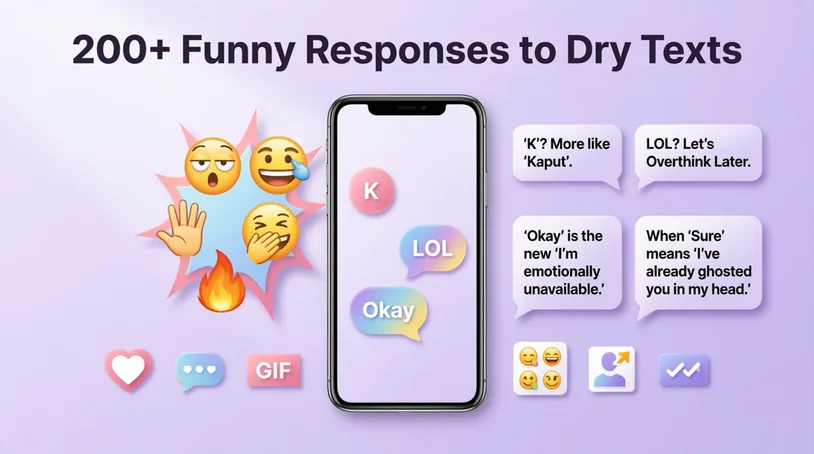
The best funny responses to dry texts turn one-word replies into playful moments without making you look desperate for attention. Whether you’re texting a crush, chatting with friends, or dealing with someone who keeps replying with “okay,” the right comeback can bring the conversation back to life.
5 quick replies: “Blink twice if your keyboard is broken,” “That reply had zero calories,” “Save some enthusiasm for the rest of us,” “Are we texting or filing paperwork?” “Your words are on a strict budget today.”
Ever send someone a whole paragraph and receive a single “lol” in return? Or ask your crush how their day went, only to get a dry “good”? We’ve all been there. Dry texts can make even the most interesting conversation feel like you’re interviewing someone who doesn’t want the job. That’s where funny responses to dry texts come in handy. Instead of overthinking every short reply, you can use humor, playful sarcasm, a little flirtation, or a confident comeback to keep things interesting.
Whether you’re dealing with a friend who texts like a robot, a crush who suddenly loses their vocabulary, or a coworker who replies with nothing but “noted,” there’s a response for every situation. The trick is knowing how to match the mood without sounding needy or unnecessarily rude.
1. Funny Responses to Dry Texts
1. “Blink twice if your keyboard is broken.” Example: When a friend keeps replying with one-word messages. Meaning: You are jokingly asking why their replies are so short.
2. “That reply had zero calories.” Example: When someone sends a completely flavorless response. Meaning: You are teasing them for giving you nothing to work with.
3. “Did your words run out of battery?” Example: When someone suddenly stops writing full sentences. Meaning: You are humorously pointing out their lack of effort.
4. “I’m framing that masterpiece.” Example: When someone replies with a plain “okay.” Meaning: You are exaggerating how unimpressive their message was.
5. “Was that the trailer or the whole conversation?” Example: When you receive a reply that contains just one word. Meaning: You are inviting them to say a little more.
6. “Your enthusiasm is truly breathtaking.” Example: When someone answers your exciting news with “cool.” Meaning: You are playfully highlighting their lack of excitement.
7. “I see we’re keeping the word count economical.” Example: When a friend sends unusually short texts. Meaning: You are joking about their minimalist texting style.
8. “Did I accidentally text a customer service bot?” Example: When every response sounds automatic and emotionless. Meaning: You are teasing them for sounding robotic.
9. “That message deserves a standing ovation.” Example: When someone sends a dry “nice.” Meaning: You are using exaggerated praise to make the moment funny.
10. “Somebody’s charging per letter today.” Example: When a person keeps their messages extremely short. Meaning: You are joking that they are trying to save words.
11. “I felt the excitement through the screen. Barely.” Example: When someone responds to your story without enthusiasm. Meaning: You are playfully calling out their low-energy reply.
12. “Please, don’t overwhelm me with all those details.” Example: When someone gives a one-word answer to your question. Meaning: You are using sarcasm to encourage a longer response.
2. Sarcastic Responses to Dry Texts
1. “Well, that was a literary masterpiece.” Example: When someone replies with a plain “yeah.” Meaning: You are sarcastically commenting on their lack of detail.
2. “Your way with words is unmatched.” Example: When their message contains almost no information. Meaning: You are teasing them for their minimal communication.
3. “I appreciate this detailed explanation.” Example: When someone answers your question with “idk.” Meaning: You are humorously highlighting how little they explained.
4. “And the conversation of the year goes to you.” Example: When a chat feels painfully one-sided. Meaning: You are mocking the lack of conversational energy.
5. “Don’t use all your words in one place.” Example: When someone sends a two-word response. Meaning: You are sarcastically suggesting that they are rationing words.
6. “Such passion. Such depth. Such a reply.” Example: When someone responds to exciting news with “okay.” Meaning: You are exaggerating how unimpressed their response makes you feel.
7. “I can tell you really thought that one through.” Example: When someone gives an obvious or lazy answer. Meaning: You are playfully questioning the effort behind their response.
8. “Your enthusiasm should be studied.” Example: When someone seems uninterested in the conversation. Meaning: You are using irony to point out their low energy.
9. “What a generous donation of words.” Example: When someone sends a tiny reply after your long message. Meaning: You are sarcastically comparing their response to a small contribution.
10. “I’m going to need a moment to process all that.” Example: When someone answers with “sure.” Meaning: You are joking about how little substance their reply contains.
11. “Oscar-worthy communication right there.” Example: When a person replies without any emotion. Meaning: You are sarcastically praising their unimpressive texting.
12. “Never stop blessing the chat with your paragraphs.” Example: When someone consistently sends one-word messages. Meaning: You are poking fun at their habit of keeping things brief.
3. Flirty Responses to Dry Texts
1. “Are you always this mysterious, or is it just with me?” Example: When your crush gives you short, intriguing replies. Meaning: You are flirting while encouraging them to open up.
2. “You’re cute, but your texting skills need work.” Example: When someone attractive keeps replying with “lol.” Meaning: You are expressing interest while playfully challenging them.
3. “Should I come over and help you find more words?” Example: When you want to turn a boring chat into playful flirting. Meaning: You are hinting at spending time together.
4. “I’m trying to flirt here. Give me something to work with.” Example: When your crush doesn’t respond to your playful messages. Meaning: You are making your romantic interest clear without being too serious.
5. “Is this your way of making me chase you?” Example: When someone keeps their replies short but continues texting. Meaning: You are playfully wondering whether they are being intentionally mysterious.
6. “Your texts are dry, but you’re still on my mind.” Example: When you like someone despite their brief replies. Meaning: You are showing affection while gently acknowledging the situation.
7. “I bet you’re more talkative in person.” Example: When you want to suggest meeting your crush. Meaning: You are opening the door to an in-person conversation.
8. “Give me one good reason to stop flirting with you.” Example: When your crush responds with a simple “haha.” Meaning: You are inviting them to return your flirtatious energy.
9. “Are you saving all your charm for our next date?” Example: When you already have a playful connection. Meaning: You are hinting at a future date while keeping things light.
10. “Your replies are short, but my curiosity isn’t.” Example: When someone keeps you interested with mysterious messages. Meaning: You are expressing curiosity without demanding attention.
11. “If I get a full sentence, is that a sign you like me?” Example: When flirting with someone who rarely elaborates. Meaning: You are playfully testing whether the interest is mutual.
12. “I’ll forgive the dry texts if you bring good conversation in person.” Example: When arranging to meet someone you like. Meaning: You are teasing them while expressing interest in spending time together.
4. Brutal but Playful Responses to Dry Texts
1. “This conversation is doing all the work without you.” Example: When you keep asking questions and getting short replies. Meaning: You are pointing out that the conversation feels one-sided.
2. “Your texting energy is on airplane mode.” Example: When someone seems completely disengaged. Meaning: You are joking about their lack of participation.
3. “I’ve had more engaging conversations with my fridge.” Example: When a chat becomes unusually dull. Meaning: You are exaggerating how boring the interaction feels.
4. “You could at least pretend to be interested.” Example: When someone repeatedly dismisses your attempts to chat. Meaning: You are directly calling attention to their apparent disinterest.
5. “I’m carrying this conversation like it’s a group project.” Example: When you are the only person asking questions. Meaning: You are saying that the effort is not being shared equally.
6. “That reply was a personal attack on my curiosity.” Example: When someone gives an unhelpfully short answer. Meaning: You are humorously expressing disappointment.
7. “I’m not interviewing you for a job, relax.” Example: When you have to ask every question to keep chatting. Meaning: You are pointing out that the exchange feels like an interview.
8. “Even your punctuation seems uninterested.” Example: When someone sends a flat, emotionless message. Meaning: You are joking that their entire texting style lacks energy.
9. “I need a conversation partner, not a typing indicator.” Example: When someone takes ages to send a tiny reply. Meaning: You want more meaningful participation.
10. “This chat has the personality of plain toast.” Example: When the conversation feels repetitive and dull. Meaning: You are calling the exchange boring in a humorous way.
11. “I’m officially retiring from carrying this chat.” Example: When you are tired of doing all the conversational work. Meaning: You are setting a boundary with a playful tone.
12. “Let me know when the other half of this conversation arrives.” Example: When the other person barely contributes. Meaning: You are suggesting that they need to participate more.
5. Cute Responses to Dry Texts
1. “A little more enthusiasm, please and thank you.” Example: When your friend replies with a plain “okay.” Meaning: You are gently asking for a warmer response.
2. “Where did my chatty little friend go?” Example: When a normally talkative friend becomes quiet over text. Meaning: You are showing affection while noticing the change.
3. “I’m sending you a virtual vocabulary boost.” Example: When someone keeps their replies short. Meaning: You are playfully encouraging them to say more.
4. “Come on, give me the deluxe version of that answer.” Example: When you want more details about their day. Meaning: You are asking for a fuller response in a friendly way.
5. “I know you’ve got more words hiding in there.” Example: When a friend gives a quick answer to an interesting question. Meaning: You are encouraging them to open up.
6. “Tiny text, big mystery.” Example: When someone sends a short but intriguing message. Meaning: You are expressing playful curiosity.
7. “Can I borrow a few more words from you?” Example: When you want to keep a conversation going. Meaning: You are gently inviting a longer reply.
8. “Your keyboard deserves a little exercise.” Example: When a friend rarely sends complete messages. Meaning: You are making a lighthearted joke about their texting habits.
9. “I’m ready for the director’s cut of that message.” Example: When someone shares only the basic details of a story. Meaning: You want to hear more of what happened.
10. “A longer reply would make my little day.” Example: When texting someone you feel close to. Meaning: You are warmly expressing that you enjoy their attention.
11. “Did your words go out for a tiny vacation?” Example: When a chatty friend suddenly becomes quiet. Meaning: You are gently teasing them about their silence.
12. “More words, same adorable person, please.” Example: When someone you like keeps sending short messages. Meaning: You are asking for more conversation with a sweet tone.
6. Confident Responses to Dry Texts
1. “I’ll match the energy you’re giving me.” Example: When someone repeatedly responds without much interest. Meaning: You are showing that you won’t keep overinvesting in the conversation.
2. “No worries, I’ll let you get back to your day.” Example: When the other person seems distracted or unavailable. Meaning: You are stepping back without making the situation awkward.
3. “I’m good with conversations that flow both ways.” Example: When you want to communicate your expectations respectfully. Meaning: You value mutual effort rather than one-sided texting.
4. “We can talk when you’ve got more time.” Example: When someone appears too busy to engage properly. Meaning: You are giving them space without taking the situation personally.
5. “Short replies won’t hurt my feelings, but I’ll notice.” Example: When you want to acknowledge a change in texting behavior. Meaning: You are confident enough to recognize the situation without overreacting.
6. “I’m here for good conversation, not word puzzles.” Example: When interpreting someone’s messages becomes exhausting. Meaning: You prefer clear communication over guessing games.
7. “I’ll leave the next topic to you.” Example: When you have been initiating every conversation. Meaning: You are giving the other person a chance to show interest.
8. “No pressure to talk if you’re not feeling it.” Example: When someone seems uninterested in continuing the chat. Meaning: You respect their mood and your own time.
9. “I like people who bring a little energy to the chat.” Example: When explaining your preference to someone you are getting to know. Meaning: You value engaged and enjoyable communication.
10. “A conversation should feel easy, not forced.” Example: When a chat repeatedly feels like hard work. Meaning: You believe mutual interest should make communication more natural.
11. “I’ll take silence over forced conversation any day.” Example: When you want to stop pushing an unresponsive exchange. Meaning: You are comfortable stepping away instead of forcing a connection.
12. “Your turn to keep this conversation alive.” Example: When you want the other person to initiate the next topic. Meaning: You are confidently inviting them to contribute.
7. Chill and Casual Responses to Dry Texts
1. “Lol, fair enough.” Example: When someone gives a short answer and you don’t want to push. Meaning: You are acknowledging their response without making a big deal of it.
2. “Haha, gotcha.” Example: When you receive a simple confirmation. Meaning: You are keeping the conversation relaxed and easygoing.
3. “Anyway, what’s the latest?” Example: When you want to move on from a dull exchange. Meaning: You are introducing a fresh topic naturally.
4. “Okay, what’s the extended version?” Example: When someone gives a short answer about their day. Meaning: You are casually inviting them to share more.
5. “Fair. What are you up to now?” Example: When the previous topic runs out of steam. Meaning: You are shifting toward a more engaging question.
6. “Noted, captain.” Example: When a friend responds with a very serious “okay.” Meaning: You are adding a little humor to an otherwise plain exchange.
7. “Cool cool, tell me something interesting.” Example: When you want to restart a slow conversation. Meaning: You are inviting the other person to introduce a new topic.
8. “We’re keeping it short today, huh?” Example: When someone seems less talkative than usual. Meaning: You are casually noticing their brief responses.
9. “Haha, I’ll take that as a yes.” Example: When someone gives a vague but positive reply. Meaning: You are keeping things light while interpreting their message.
10. “So, anything fun happening?” Example: When you need an easy way to revive a quiet chat. Meaning: You are opening the door to a more interesting conversation.
11. “All right, what’s the next episode?” Example: When you want to move your chat toward a new subject. Meaning: You are playfully encouraging the conversation to continue.
12. “No stress, we’ll try this conversation again later.” Example: When both people seem distracted or tired. Meaning: You are letting the exchange pause without creating tension.
8. Clever Responses to Dry Texts
1. “Your message has been received. Additional context pending.” Example: When someone sends a mysterious one-word answer. Meaning: You are humorously asking for clarification.
2. “I see the words, but where’s the plot?” Example: When a reply offers no useful details. Meaning: You want the conversation to become more interesting.
3. “That answer left more questions than it solved.” Example: When someone gives an incomplete response. Meaning: You are pointing out that their message needs elaboration.
4. “Is this the minimalist edition of texting?” Example: When someone consistently uses very few words. Meaning: You are cleverly describing their concise texting style.
5. “Your message has excellent brevity and questionable detail.” Example: When someone gives an extremely short explanation. Meaning: You are playfully acknowledging the lack of information.
6. “Please submit the full report.” Example: When a friend gives a vague update about their day. Meaning: You are asking for more details in a mock-formal way.
7. “I detect a shortage of conversational content.” Example: When a chat seems to have run out of substance. Meaning: You are pointing out the lack of meaningful discussion.
8. “Was there a character limit I wasn’t informed about?” Example: When someone replies with only a few letters. Meaning: You are joking about their unusually brief messages.
9. “Your reply is technically correct but emotionally unavailable.” Example: When someone answers a question without showing interest. Meaning: You are distinguishing between answering and actually engaging.
10. “Can you provide supporting evidence for that ‘fine’?” Example: When someone says they are fine but seems unusually quiet. Meaning: You are playfully inviting them to explain how they feel.
11. “The message is short, but the mystery is enormous.” Example: When you cannot tell what someone means from their reply. Meaning: You are highlighting how vague their message feels.
12. “I’m requesting a revised version with more personality.” Example: When a friend gives a boring response to your joke. Meaning: You are asking them to respond with more character and humor.
9. Polite Responses to Dry Texts
1. “No worries! Feel free to tell me more when you have time.” Example: When someone seems busy while replying. Meaning: You are giving them space while remaining friendly.
2. “Thanks for letting me know. How has the rest of your day been?” Example: When you want to continue a conversation politely. Meaning: You are acknowledging their response and offering another topic.
3. “All good! We can catch up another time.” Example: When a conversation isn’t progressing naturally. Meaning: You are ending the exchange on a positive note.
4. “I hope I’m not catching you at a busy time.” Example: When someone gives unusually short responses. Meaning: You are checking whether they are available to chat.
5. “Whenever you’re free, I’d love to hear the full story.” Example: When someone shares only a small part of an experience. Meaning: You are showing interest without demanding an immediate response.
6. “No pressure, just checking in.” Example: When a friend seems less talkative than usual. Meaning: You are expressing care without expecting a long conversation.
7. “Happy to pick this up whenever it suits you.” Example: When a discussion needs more attention than the person can give. Meaning: You are being considerate about their availability.
8. “Thanks! Let me know if there’s anything else you’d like to add.” Example: When someone provides a short answer to a practical question. Meaning: You are politely leaving room for more information.
9. “Sounds good. Hope everything is going well on your end.” Example: When you want to respond warmly to a brief message. Meaning: You are maintaining a friendly tone without pushing for more.
10. “I understand. We can talk when you’re in the mood.” Example: When someone seems emotionally tired or distracted. Meaning: You are respecting their mood and giving them space.
11. “Thanks for the reply! I’d be interested in hearing your thoughts.” Example: When you need more detail about a subject. Meaning: You are inviting a fuller answer in a respectful way.
12. “No problem at all. Have a lovely rest of your day!” Example: When you want to close a quiet conversation gracefully. Meaning: You are ending the exchange with warmth and courtesy.
10. Professional Responses to Dry Texts
1. “Thanks for confirming. Could you share a little more detail?” Example: When a colleague responds to a work question with “yes.” Meaning: You are requesting the information needed to proceed.
2. “Understood. Please let me know if there are any updates.” Example: When a coworker gives a brief project status. Meaning: You are keeping communication clear and professional.
3. “Thanks. Could you clarify what the next step will be?” Example: When a work message doesn’t explain what happens next. Meaning: You are seeking actionable information.
4. “Got it. Is there anything else I should take into account?” Example: When you receive a short instruction from a manager. Meaning: You are checking whether additional context is needed.
5. “Appreciate the update. I’ll wait for further details.” Example: When a colleague sends a brief progress report. Meaning: You are acknowledging their message and leaving room for follow-up.
6. “Thanks for the quick reply. Could we expand on that point?” Example: When a teammate gives a short answer during planning. Meaning: You are requesting a more complete explanation.
7. “Noted. A little more context would help me move forward.” Example: When you need clarification before completing a task. Meaning: You are explaining why further information matters.
8. “Thanks! Just checking that we’re aligned on the details.” Example: When a brief response leaves room for misunderstanding. Meaning: You are confirming shared expectations.
9. “Could you confirm the timeline as well?” Example: When a coworker answers a project question incompletely. Meaning: You are requesting a specific missing detail.
10. “I appreciate the confirmation. Please share any relevant changes.” Example: When coordinating work with a busy colleague. Meaning: You are keeping the exchange concise and practical.
11. “Would you mind elaborating on that when convenient?” Example: When you need more detail without interrupting someone’s schedule. Meaning: You are politely requesting a fuller response.
12. “Thanks, I’ll proceed based on that. Please correct me if needed.” Example: When you need to act on a short work message. Meaning: You are clarifying your understanding while allowing corrections.
11. Dramatic Responses to Dry Texts
1. “I poured my heart into that message, and you gave me three letters.” Example: When you send an excited message and receive “lol.” Meaning: You are exaggerating your disappointment for comic effect.
2. “I shall remember this betrayal forever.” Example: When your best friend gives you a boring reply. Meaning: You are pretending that their short message is a serious offense.
3. “And just like that, the conversation entered its darkest era.” Example: When a lively chat suddenly becomes dull. Meaning: You are dramatically describing the loss of conversational energy.
4. “I fear our friendship may never recover from this ‘k.’” Example: When a close friend sends a blunt acknowledgment. Meaning: You are joking about how underwhelming their reply feels.
5. “My expectations were high, and your word count was low.” Example: When you hoped for an enthusiastic answer. Meaning: You are humorously contrasting your expectations with their response.
6. “The silence between your words is deafening.” Example: When someone sends a message with almost no emotion. Meaning: You are dramatizing how little their reply communicates.
7. “I need three business days to recover from that response.” Example: When a friend gives you an unexpectedly dry reply. Meaning: You are pretending their message has emotionally exhausted you.
8. “Somewhere, a conversation therapist just felt a disturbance.” Example: When your chat becomes painfully awkward. Meaning: You are joking that the conversation needs professional help.
9. “I expected a chapter, and you delivered a punctuation mark.” Example: When someone responds to your long story with “.” or “k.” Meaning: You are exaggerating the difference between your efforts.
10. “Tell my future biographer I tried to keep this chat alive.” Example: When you have repeatedly attempted to revive a dull exchange. Meaning: You are humorously portraying yourself as a conversation hero.
11. “The plot thickens, but your replies do not.” Example: When you share an interesting story and get little reaction. Meaning: You are teasing someone for failing to match your excitement.
12. “I came, I texted, I received ‘okay.’” Example: When you receive a bland response after making an effort. Meaning: You are turning a disappointing texting moment into a mock victory speech.
12. Sweet Responses to Dry Texts
1. “I always enjoy hearing from you, even when you’re being brief.” Example: When someone you care about sends a short message. Meaning: You are showing affection without criticizing their texting style.
2. “Tell me more whenever you feel like talking.” Example: When a friend seems quiet over text. Meaning: You are offering a welcoming space for conversation.
3. “I’m all ears if there’s more on your mind.” Example: When someone gives a vague response about their feelings. Meaning: You are letting them know you are ready to listen.
4. “Your day deserves more than a one-word review.” Example: When asking someone close to you about their day. Meaning: You are warmly encouraging them to share their experiences.
5. “I hope your short replies mean you’re busy doing something wonderful.” Example: When a loved one is less talkative than usual. Meaning: You are giving them the benefit of the doubt.
6. “Sending a little sunshine to your quiet corner.” Example: When you want to brighten a friend’s day. Meaning: You are offering warmth without expecting an immediate reply.
7. “I’m here for the short version or the ten-page version.” Example: When a friend might need someone to talk to. Meaning: You are showing that you are willing to listen either way.
8. “I hope everything is okay on your side.” Example: When someone’s texting behavior changes unexpectedly. Meaning: You are checking in with genuine concern.
9. “Whenever you want to chat properly, I’m around.” Example: When you want to keep the door open for a friend. Meaning: You are expressing availability without pressuring them.
10. “Even a little message from you can brighten my day.” Example: When someone special sends a brief greeting. Meaning: You are sharing appreciation for their presence.
11. “No need for perfect words. Just be yourself.” Example: When someone seems hesitant to express themselves. Meaning: You are encouraging comfortable, authentic communication.
12. “I’ll save you a spot in my next interesting conversation.” Example: When a chat has gone quiet but you want to reconnect. Meaning: You are playfully expressing that you enjoy talking with them.
13. Responses to Dry Texts From Your Crush
1. “Is your flirting style mysterious silence?” Example: When your crush responds to a playful message with one word. Meaning: You are teasing them about their communication style.
2. “I’m starting to think your phone has a crush on the letter K.” Example: When their favorite reply seems to be “k.” Meaning: You are playfully pointing out their repetitive messages.
3. “Should I send you a multiple-choice question instead?” Example: When open-ended questions get very short answers. Meaning: You are making it easier for them to respond while keeping things funny.
4. “I promise I don’t bite. You can use complete sentences.” Example: When your crush seems shy over text. Meaning: You are inviting them to relax and talk more freely.
5. “Are you shy, busy, or secretly writing a novel?” Example: When you’re unsure why your crush is responding briefly. Meaning: You are offering playful explanations without making assumptions.
6. “Your texting game needs a little romantic soundtrack.” Example: When you want to flirt without being too direct. Meaning: You are joking that their messages need more charm.
7. “I’ll give you one more chance to impress me with a sentence.” Example: When you share playful banter with someone you like. Meaning: You are teasing them into making more conversational effort.
8. “Is this the part where I’m supposed to read between the lines?” Example: When your crush sends a vague response. Meaning: You are humorously asking them to be more direct.
9. “You’re making me work harder than a detective.” Example: When interpreting their short messages takes too much effort. Meaning: You are expressing playful frustration about their unclear communication.
10. “Let’s skip the dry texting and get to the good conversation.” Example: When you want to suggest a call or meeting. Meaning: You are showing interest in a more engaging interaction.
11. “One full sentence and I’ll consider myself lucky.” Example: When your crush rarely gives detailed responses. Meaning: You are making a lighthearted request for more effort.
12. “If you’re interested, give me a little more than ‘haha.’” Example: When you want to understand whether the flirting is mutual. Meaning: You are encouraging clearer communication about their interest.
14. Responses to Dry Texts From Friends
1. “Bestie, I need the premium subscription, not the free trial.” Example: When your best friend sends a short reply to your story. Meaning: You are joking that your friendship deserves better conversation.
2. “Who are you, and what have you done with my chatty friend?” Example: When a normally talkative friend suddenly becomes quiet. Meaning: You are playfully noticing their unusual texting behavior.
3. “Friendship level: paragraphs. Your current level: punctuation.” Example: When your friend gives you a one-word answer. Meaning: You are teasing them about the gap between your usual conversations.
4. “I’m sending this chat to the friendship maintenance department.” Example: When the conversation keeps stalling. Meaning: You are pretending your friendship needs a little technical support.
5. “Bestie, blink twice if you’re texting under duress.” Example: When your friend sounds unusually uninterested. Meaning: You are humorously checking whether something is wrong.
6. “I know you have gossip. Release it.” Example: When your friend says “nothing” after you ask what’s new. Meaning: You are playfully encouraging them to share the details.
7. “Did our group chat steal all your words?” Example: When a friend who usually chats a lot becomes quiet in private messages. Meaning: You are joking about their change in texting energy.
8. “You owe me at least one interesting story.” Example: When catching up with a friend after a long day. Meaning: You are inviting them to contribute something fun.
9. “This is not the friendship content I subscribed to.” Example: When your usual banter turns into one-word replies. Meaning: You are playfully asking for your normal dynamic back.
10. “Should I send memes until you regain your vocabulary?” Example: When your friend seems too tired to chat. Meaning: You are offering a funny way to restart the conversation.
11. “I’ll be accepting applications for a more talkative bestie.” Example: When your friend repeatedly sends dry messages. Meaning: You are exaggerating your disappointment in a friendly way.
12. “Okay, but save the actual conversation for our catch-up.” Example: When texting is not working but you still want to connect. Meaning: You are suggesting a more enjoyable way to spend time together.
15. Responses When Someone Keeps Sending Dry Texts
1. “Is everything okay? You seem a little quieter than usual.” Example: When someone’s communication changes noticeably. Meaning: You are checking in instead of assuming they are uninterested.
2. “I’m happy to chat, but I don’t want to force a conversation.” Example: When you have repeatedly tried to keep the exchange going. Meaning: You are expressing your preference for mutual effort.
3. “Maybe we’re both out of conversation fuel today.” Example: When neither person seems able to keep the chat going. Meaning: You are making the situation feel normal rather than awkward.
4. “I’ll let you get back to your day. Talk soon!” Example: When the other person seems occupied. Meaning: You are ending the exchange politely and leaving room to reconnect.
5. “I’m getting the feeling this isn’t the best time to talk.” Example: When someone repeatedly gives short, distracted replies. Meaning: You are gently acknowledging that the timing may be wrong.
6. “Let’s pick a topic we’re both excited about.” Example: When the current subject produces little conversation. Meaning: You are suggesting a fresh start instead of blaming anyone.
7. “I think our conversation needs a commercial break.” Example: When a chat has become repetitive. Meaning: You are humorously suggesting a pause.
8. “I’ll leave the next message to you.” Example: When you want to see whether the other person will initiate. Meaning: You are creating space for them to show interest.
9. “No hard feelings if you’re not in a texting mood.” Example: When someone seems too tired to communicate. Meaning: You are respecting their mood without taking it personally.
10. “We might be better at talking face-to-face.” Example: When you enjoy someone’s company but struggle over text. Meaning: You are suggesting that the communication style may be the issue.
11. “I’ll stop interrogating you now.” Example: When you realize you have asked every question. Meaning: You are joking about the one-sided nature of the exchange.
12. “Good conversations need two people, so I’ll give this one some space.” Example: When the other person continues to show little interest. Meaning: You are calmly stepping back and allowing the interaction to develop naturally.
Frequently Asked Questions
What does a dry text mean?
A dry text is a short or low-energy message that gives little detail or emotion.
What is the best funny response to a dry text?
Try “Blink twice if your keyboard is broken” to keep the moment lighthearted.
Are dry texts a sign someone is not interested?
Not always. They may be busy, tired, distracted, or simply prefer brief messages.
How do you respond to dry texts from your crush?
Use a playful reply like “Are you always this mysterious, or is it just with me?”
How do you reply to a dry text professionally?
Keep it polite and direct, such as “Thanks for confirming. Could you share more details?”
What should you say if you don’t mean to sound dry?
Add context, ask a question, or share a little more about what you mean.
Is humor appropriate when replying to dry texts?
Yes, if you know the person enjoys jokes. Use a gentle response if you’re unsure.
Should you double-text someone who sends dry replies?
You can send another message when appropriate, but avoid repeatedly chasing someone who doesn’t engage.
How can you make a dry conversation interesting?
Introduce a fun topic, ask an open-ended question, or share an amusing story.
Should you stop texting someone who always sends dry replies?
If the effort stays one-sided, consider stepping back and seeing whether they initiate.
Conclusion
Dry texts don’t have to ruin a good conversation. With the right funny responses to dry texts, you can add humor, show confidence, flirt naturally, or politely step away when the energy isn’t mutual. The key is choosing a reply that fits your relationship and the situation. A playful comeback might make your crush smile, a clever line might revive a friendship, and a calm response might help you avoid unnecessary overthinking.
Remember, you don’t have to carry every conversation alone. Try a few of these replies, save your favorites, and share them with friends who are tired of receiving one-word messages. Keep texting fun, stay authentic, and let the conversation flow!