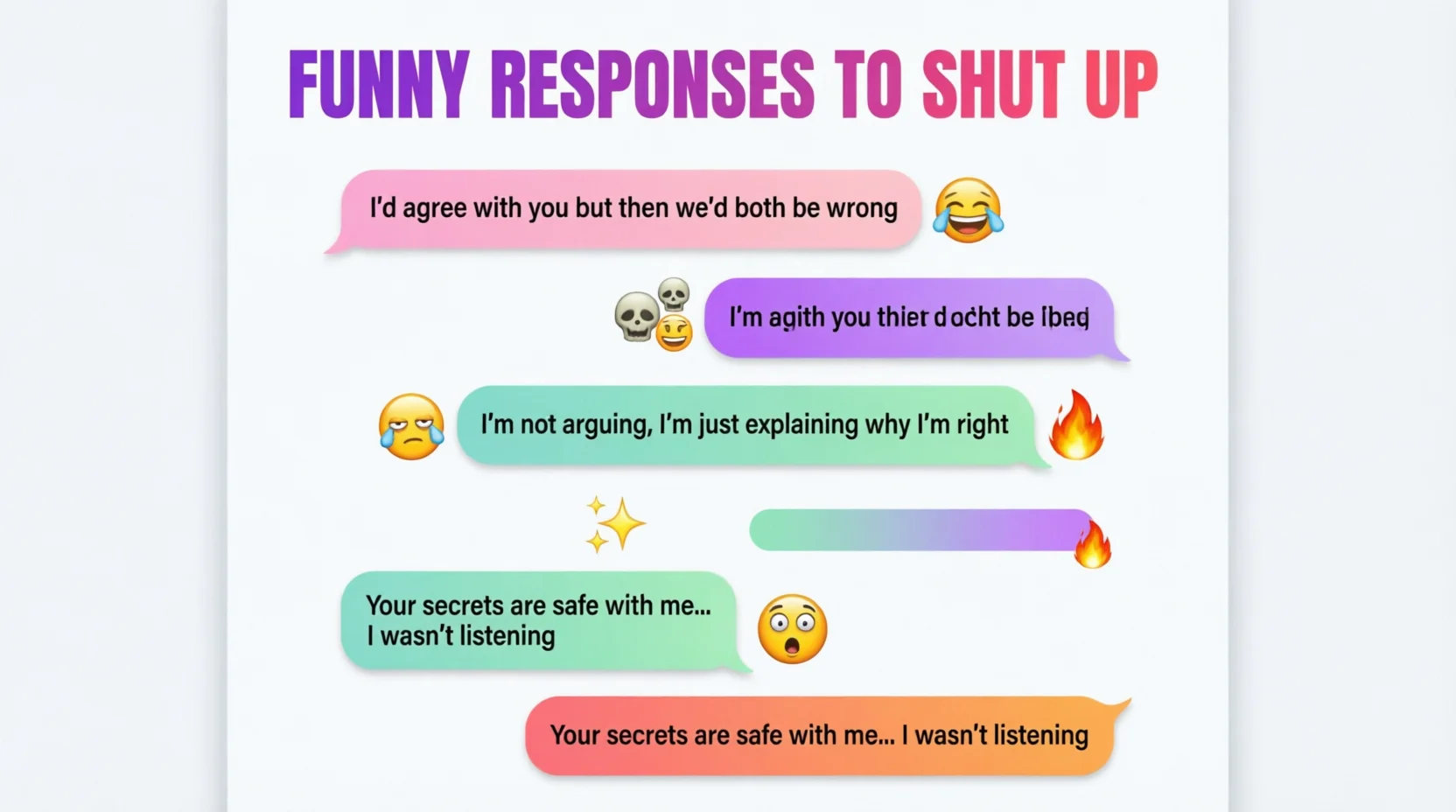
The best funny responses to shut up can turn an awkward moment into a laugh without making things unnecessarily serious. Pick a reply based on whether you want to be playful, sarcastic, confident, or polite.
Top alternatives: “Make me.”, “After you.”, “My mute button is broken.”, “I was just getting started.”, “You first.”
Someone tells you to “shut up,” and suddenly your brain starts searching for the perfect comeback. Maybe it happens during a group chat, a playful argument with friends, a random DM, at work, or when your crush decides to tease you. The right response can completely change the mood. Instead of getting annoyed, you can answer with humor, confidence, sarcasm, or a perfectly timed one-liner. That is why finding funny responses to shut up can be surprisingly useful.
A good comeback keeps the conversation entertaining while showing that you can handle teasing without taking everything personally. Whether you want something clever, flirty, polite, dramatic, or completely unexpected, the best response is the one that sounds natural coming from you. Sometimes, one funny sentence is all it takes to win the moment without starting World War III.
Funny Responses
- “Make me.”
Use this when a friend jokingly tries to silence you.
Meaning: It playfully challenges them without taking the moment too seriously. - “I was just warming up.”
Use this after someone tells you to stop talking.
Meaning: You are jokingly announcing that the real conversation has not even started. - “Sorry, my mute button is missing.”
Use this when you want a silly technology-themed comeback.
Meaning: You are pretending your inability to stop talking is a technical problem. - “That sounds like a you problem.”
Use this when someone clearly cannot handle your energy.
Meaning: You are humorously shifting the responsibility back to them. - “Bold of you to assume I listen.”
Use this with friends who know you rarely follow instructions.
Meaning: You are confidently refusing the command in a playful way. - “I would, but I have things to say.”
Use this when you want a simple witty comeback.
Meaning: You are jokingly prioritizing your opinion over their request. - “Okay, after this one tiny speech.”
Use this when you know you are talking too much.
Meaning: You acknowledge the joke while pretending your story is extremely important. - “Sorry, the podcast is still recording.”
Use this when your friends complain about your talking.
Meaning: You turn your nonstop commentary into a fake podcast joke. - “Did you just subscribe to silence?”
Use this when someone suddenly wants peace and quiet.
Meaning: You humorously question their unexpected demand for silence. - “I tried silence once. Not my thing.”
Use this when you want a playful personality-based reply.
Meaning: You are joking that being quiet simply does not match your personality. - “One second, I need to finish being hilarious.”
Use this when someone interrupts your joke.
Meaning: You jokingly act as though your comedy deserves uninterrupted airtime. - “Your request has been received and ignored.”
Use this for a mock-official comeback.
Meaning: You humorously acknowledge their request while refusing to follow it.
Brutal Responses
- “You first.”
Use this when someone is trying to boss you around.
Meaning: You turn their command right back toward them. - “I would, but then who would entertain you?”
Use this when the person secretly enjoys your attention.
Meaning: You jokingly suggest they need your conversation. - “You seem unusually invested in my voice.”
Use this when someone keeps commenting on your talking.
Meaning: You point out their attention in a confident, teasing way. - “That was almost convincing.”
Use this after receiving a weak command.
Meaning: You humorously suggest their authority did not impress you. - “Interesting opinion. Moving on.”
Use this when you want to dismiss the comment casually.
Meaning: You show that their demand will not control the conversation. - “I appreciate the feedback I did not request.”
Use this when someone gives unnecessary instructions.
Meaning: You politely package a pointed dismissal as formal feedback. - “You really thought that would work?”
Use this when someone clearly underestimated you.
Meaning: You confidently highlight how ineffective their command was. - “That confidence is adorable.”
Use this when someone acts overly authoritative.
Meaning: You tease them for believing they have control over you. - “I heard you. I just chose peace for myself.”
Use this when you want a calm but pointed reply.
Meaning: You make it clear that ignoring them is intentional. - “Your volume does not equal authority.”
Use this when someone is being overly forceful.
Meaning: You remind them that being loud does not make them in charge. - “Noted. Absolutely nothing will change.”
Use this when someone gives an order you do not plan to follow.
Meaning: You humorously reject their request while staying composed. - “That command needs a software update.”
Use this when you want a modern tech-inspired comeback.
Meaning: You joke that their attempt at authority is outdated.
Flirty Responses
- “Only if you say please.”
Use this when playful chemistry is already part of the conversation.
Meaning: You turn the command into a teasing invitation. - “Make me blush first.”
Use this when you want to add a cute romantic twist.
Meaning: You playfully challenge them to impress you. - “You like hearing me talk too much anyway.”
Use this with someone who enjoys your attention.
Meaning: You tease them by suggesting they secretly love your conversation. - “You could just admit you like my voice.”
Use this when the conversation has a flirtatious vibe.
Meaning: You turn their complaint into a playful compliment. - “I would, but you look cute when you complain.”
Use this when teasing someone you like.
Meaning: You transform their irritation into a flirtatious compliment. - “Ask nicely and I might consider it.”
Use this when you want a confident playful reply.
Meaning: You invite them to make the request more charmingly. - “Are you flirting or giving instructions?”
Use this when their teasing feels suspiciously romantic.
Meaning: You playfully call attention to possible attraction. - “You just want my attention.”
Use this when someone keeps engaging with you.
Meaning: You tease them for pretending they want silence. - “I could stop talking, but then you might miss me.”
Use this when you want a sweet, confident flirt.
Meaning: You jokingly suggest your presence is something they would miss. - “Your wish for silence has been denied.”
Use this when you want a playful power move.
Meaning: You keep the mood light while confidently refusing. - “Careful, that attitude is almost attractive.”
Use this when playful tension is already present.
Meaning: You turn their boldness into a teasing compliment. - “You say shut up, but you keep replying.”
Use this when they clearly enjoy the conversation.
Meaning: You point out their actions suggest they want you to continue.
Polite Responses
- “I’ll keep that in mind.”
Use this when you want to stay calm instead of arguing.
Meaning: You acknowledge the request without creating tension. - “Fair enough, I’ll give you a quiet moment.”
Use this when someone genuinely needs some space.
Meaning: You respond respectfully while keeping the mood friendly. - “Got it, I’ll tone it down.”
Use this when your conversation has become a little too energetic.
Meaning: You show that you can respect someone’s preference. - “Understood. I was only joking.”
Use this when your humor may have gone too far.
Meaning: You clarify that you did not intend to upset them. - “No worries, I’ll let you enjoy the silence.”
Use this when you want a graceful exit.
Meaning: You respond warmly without taking offense. - “Message received.”
Use this when you want a short, neutral reply.
Meaning: You confirm that you understood what they meant. - “Okay, I’ll give you a break from my commentary.”
Use this when friends are teasing you about talking.
Meaning: You acknowledge the joke with light humor. - “Fair request.”
Use this when the other person has a reasonable point.
Meaning: You accept their request without unnecessary drama. - “I hear you.”
Use this when you want to keep things mature.
Meaning: You show that their words have been acknowledged. - “Alright, I’ll behave.”
Use this when the situation is playful.
Meaning: You offer a lighthearted promise to calm down. - “Okay, peace mode activated.”
Use this when you want a friendly modern response.
Meaning: You humorously signal that you are ready to be quiet. - “I’ll save the rest for later.”
Use this when you have more to say but want to pause.
Meaning: You suggest continuing the conversation another time.
Professional Responses
- “I’m happy to continue once we can keep the conversation respectful.”
Use this when a workplace conversation becomes disrespectful.
Meaning: You calmly establish a boundary. - “Let’s keep the discussion constructive.”
Use this during a tense professional exchange.
Meaning: You redirect the conversation toward productive communication. - “I’d prefer if we kept the tone professional.”
Use this when someone speaks to you disrespectfully at work.
Meaning: You clearly request respectful communication. - “I’ll finish my point, then I’m happy to hear yours.”
Use this when someone interrupts you during a meeting.
Meaning: You confidently ask for space to complete your thought. - “Let’s give everyone a chance to speak.”
Use this when a discussion becomes competitive.
Meaning: You promote fairness instead of responding emotionally. - “I understand your frustration.”
Use this when someone reacts strongly to your comments.
Meaning: You acknowledge their emotion without escalating the situation. - “Let’s focus on the issue rather than the tone.”
Use this when a professional discussion gets personal.
Meaning: You guide attention back toward the actual topic. - “I’m open to feedback when it is respectful.”
Use this when someone delivers criticism poorly.
Meaning: You accept useful feedback while setting a communication boundary. - “I’ll pause here and let you respond.”
Use this when you want to de-escalate a conversation.
Meaning: You calmly create room for the other person to speak. - “Let’s revisit this when we can discuss it calmly.”
Use this when emotions are getting too high.
Meaning: You suggest continuing the discussion under better conditions. - “I think we can communicate this more effectively.”
Use this when someone’s wording is unnecessarily harsh.
Meaning: You encourage better communication without attacking them. - “I’m listening, so let’s keep this productive.”
Use this when you want to remain composed.
Meaning: You show openness while maintaining a professional boundary.
Creative Responses
- “Silence has left the group chat.”
Use this when you want an internet-style joke.
Meaning: You pretend silence has dramatically exited the conversation. - “My inner narrator disagrees.”
Use this when someone tells you to stop talking.
Meaning: You jokingly blame your imaginary narrator for continuing. - “Breaking news: I have more to say.”
Use this for a dramatic social-media-style comeback.
Meaning: You make your continued talking sound like headline news. - “Unfortunately, my words are on unlimited data.”
Use this when you want a clever phone-themed response.
Meaning: You joke that nothing can stop your talking. - “The silence department is currently closed.”
Use this when someone asks you to be quiet.
Meaning: You invent a fake department to make the situation funny. - “I regret to inform you that I cannot.”
Use this when you want mock-formal humor.
Meaning: You make a simple refusal sound like an official announcement. - “My microphone has entered its main-character era.”
Use this when everyone is tired of hearing you talk.
Meaning: You jokingly pretend your voice is demanding the spotlight. - “Quiet mode requires a premium subscription.”
Use this when someone asks for silence.
Meaning: You pretend being quiet is an expensive feature. - “My thoughts have no customer service line.”
Use this when your brain keeps producing commentary.
Meaning: You humorously suggest your thoughts cannot be controlled. - “The talking train has already left the station.”
Use this when you have already started telling a story.
Meaning: You joke that stopping now is impossible. - “Silence? I don’t have that app installed.”
Use this when you want a tech-inspired response.
Meaning: You jokingly claim quietness is unavailable to you. - “Please hold while I finish this important nonsense.”
Use this when you are telling a silly story.
Meaning: You openly admit the conversation is ridiculous but entertaining.
Sarcastic Responses
- “Oh no, should I call the silence police?”
Use this when someone dramatically demands quiet.
Meaning: You exaggerate their request for comic effect. - “Thank you for your incredibly important announcement.”
Use this when someone tells you to stop talking.
Meaning: You sarcastically pretend their command deserves an award. - “Wow, what a powerful speech.”
Use this after receiving an unnecessary command.
Meaning: You mock the seriousness of their statement. - “I’ll file that under things I didn’t ask for.”
Use this when someone offers unwanted instructions.
Meaning: You dismiss their comment with dry humor. - “Your request has been forwarded to absolutely nobody.”
Use this when you want a sarcastic response.
Meaning: You humorously announce that their request will be ignored. - “Congratulations, you have discovered the word ‘quiet.’”
Use this when someone keeps telling you to stop talking.
Meaning: You tease them for repeatedly demanding silence. - “What an unexpected contribution to society.”
Use this when their comment adds little value.
Meaning: You sarcastically pretend their command was extremely useful. - “I’ll consider your suggestion during my next meeting with myself.”
Use this when you want dry humor.
Meaning: You jokingly imply that you alone make the decision. - “Thank you for participating.”
Use this when ending a playful argument.
Meaning: You humorously treat the conversation like a completed contest. - “Your concern has been noted in invisible ink.”
Use this when you want an unusual sarcastic comeback.
Meaning: You acknowledge their comment while implying it has no impact. - “I can tell you rehearsed that.”
Use this when their command sounds overly dramatic.
Meaning: You jokingly suggest they prepared the comeback in advance. - “That sounded much better in your head, right?”
Use this when someone gives a weak comeback.
Meaning: You playfully point out that their remark was unimpressive.
Cute Responses
- “Okay, but only for five seconds.”
Use this when a friend playfully asks you to be quiet.
Meaning: You agree in a cute and unserious way. - “Fine, tiny silence break.”
Use this when you want a soft response.
Meaning: You turn the request into something playful and harmless. - “But I have important little thoughts.”
Use this when you want to sound adorably dramatic.
Meaning: You jokingly defend your need to share your thoughts. - “Okay, I’ll whisper my nonsense.”
Use this when you want to keep joking quietly.
Meaning: You agree while preserving the playful mood. - “You can’t silence this little chatterbox.”
Use this when your friends know you talk a lot.
Meaning: You affectionately embrace your talkative personality. - “Fine, but don’t miss me too much.”
Use this when temporarily ending a conversation.
Meaning: You turn silence into a sweet little tease. - “Okay, I’ll be good now.”
Use this when someone playfully calls you out.
Meaning: You respond with a gentle and cheerful promise. - “My bad, I got excited.”
Use this when you have been talking enthusiastically.
Meaning: You admit your excitement in a warm, relatable way. - “Quiet mode, but make it cute.”
Use this when joking with friends.
Meaning: You turn the idea of silence into a playful mood. - “Okay, I’ll let your ears rest.”
Use this when someone jokingly complains about your talking.
Meaning: You acknowledge their teasing without taking offense. - “I promise I’m almost done.”
Use this when finishing a long story.
Meaning: You reassure them while keeping the mood light. - “Fine, but my thoughts are still loud.”
Use this when you want a cute, relatable reply.
Meaning: You joke that being quiet does not stop your busy mind.
Dramatic Responses
- “Silence me? After everything we’ve been through?”
Use this when you want to exaggerate a simple moment.
Meaning: You turn an ordinary request into a fake emotional crisis. - “So this is how my story ends.”
Use this when someone interrupts your conversation.
Meaning: You humorously act as though the moment is tragic. - “I cannot believe I have been silenced.”
Use this when friends tease you about talking.
Meaning: You dramatically pretend their request is a historic event. - “Tell my story when I’m gone.”
Use this for exaggerated theatrical humor.
Meaning: You make being quiet sound far more serious than it is. - “My voice has been cancelled.”
Use this when someone asks you to stop talking.
Meaning: You turn the moment into a dramatic social-media joke. - “And just like that, my freedom disappeared.”
Use this when someone tries to control the conversation.
Meaning: You exaggerate the situation for comedic effect. - “I was not prepared for this betrayal.”
Use this when a friend tells you to shut up.
Meaning: You pretend their request is a shocking act of disloyalty. - “This silence feels historically significant.”
Use this when you finally stop talking.
Meaning: You humorously exaggerate how unusual your silence is. - “The audience has spoken.”
Use this when several people tell you to quiet down.
Meaning: You pretend the group has voted you off the conversation. - “My final words were actually very important.”
Use this when someone interrupts your story.
Meaning: You create fake suspense around something completely ordinary. - “I shall retreat into the shadows.”
Use this when ending a playful conversation.
Meaning: You dramatically announce your temporary disappearance. - “Remember me as I was: extremely talkative.”
Use this when pretending to accept defeat.
Meaning: You turn a simple request for quiet into theatrical comedy.
Chill And Casual Responses
- “Haha, okay.”
Use this when you want to keep the mood relaxed.
Meaning: You acknowledge the comment without making it serious. - “Fair enough.”
Use this when you accept the joke casually.
Meaning: You show that you are not bothered by the request. - “Alright, I’ll chill.”
Use this when the conversation has become too energetic.
Meaning: You agree to calm down without making a big deal about it. - “My bad, I got carried away.”
Use this after talking for longer than expected.
Meaning: You casually admit that you became overly enthusiastic. - “Okay, okay, I hear you.”
Use this when a friend playfully complains.
Meaning: You acknowledge them while keeping the mood easygoing. - “Lol, noted.”
Use this when you want a quick text-friendly reply.
Meaning: You recognize the request without taking it seriously. - “Alright, peace.”
Use this when you want to end the exchange smoothly.
Meaning: You keep things relaxed and friendly. - “Gotcha.”
Use this when you want a simple acknowledgment.
Meaning: You show that you understood without overexplaining. - “Okay, I’ll give you a minute.”
Use this when someone wants a little quiet time.
Meaning: You respect their space without creating tension. - “Haha, my enthusiasm got ahead of me.”
Use this when you have been talking excitedly.
Meaning: You lightly blame your excitement for the extra chatter. - “No stress.”
Use this when you want to keep things peaceful.
Meaning: You show that the comment did not offend you. - “All good, I know you’re joking.”
Use this when the person is clearly teasing.
Meaning: You confirm that you understand the playful intention.
Confident Responses
- “I’ll stop when I’m finished.”
Use this when you want to sound calm and self-assured.
Meaning: You confidently maintain control over your own conversation. - “I know when to speak and when to listen.”
Use this during a more serious interaction.
Meaning: You show confidence in your communication skills. - “You don’t have to agree with me.”
Use this when someone dislikes your opinion.
Meaning: You make it clear that disagreement does not intimidate you. - “I’m comfortable saying what I think.”
Use this when someone challenges your willingness to speak.
Meaning: You confidently stand behind your voice and opinions. - “I heard you, but I’m not bothered.”
Use this when someone tries to provoke you.
Meaning: You show emotional control instead of reacting defensively. - “I’ll decide when I’m done.”
Use this when someone tries to rush you.
Meaning: You assert control over your own participation. - “You can disagree without dismissing me.”
Use this when the situation becomes disrespectful.
Meaning: You establish a clear boundary while staying composed. - “I don’t need permission to speak.”
Use this when someone attempts to control your voice.
Meaning: You confidently defend your right to express yourself. - “I said what I said.”
Use this when you want a concise confident ending.
Meaning: You stand firmly behind your statement. - “Respectfully, I’ll finish my point.”
Use this when someone interrupts you.
Meaning: You assert yourself without becoming unnecessarily hostile. - “Confidence sounds loud to some people.”
Use this when someone dislikes your assertiveness.
Meaning: You suggest that your confidence may be what bothers them. - “I’m not here to shrink myself.”
Use this when you want an empowering response.
Meaning: You refuse to make yourself smaller simply to please others.
Emotional Responses
- “Okay, I didn’t realize I was bothering you.”
Use this when the comment genuinely hurts your feelings.
Meaning: You honestly communicate that their words affected you. - “I can be quiet, but I hope we can talk respectfully.”
Use this when you want to lower the tension.
Meaning: You accept the request while asking for kindness. - “That came across a little harsh.”
Use this when someone speaks more sharply than necessary.
Meaning: You calmly explain how their words felt. - “I was only trying to connect with you.”
Use this when your conversation came from genuine care.
Meaning: You clarify that your intention was positive. - “I didn’t mean to make things uncomfortable.”
Use this when you sense the other person is upset.
Meaning: You show awareness and concern for their feelings. - “Okay, I’ll give you some space.”
Use this when someone clearly needs distance.
Meaning: You respect their emotional boundary. - “I wish you had said that more kindly.”
Use this when the message itself was unnecessarily harsh.
Meaning: You express your feelings while encouraging better communication. - “I hear you, even if that was hard to hear.”
Use this during an honest conversation.
Meaning: You acknowledge their message while admitting it affected you. - “Let’s not hurt each other over a conversation.”
Use this when an argument is becoming personal.
Meaning: You encourage both people to step away from unnecessary conflict. - “I care about what you think, but tone matters too.”
Use this with someone whose words feel disrespectful.
Meaning: You value their opinion while asking for considerate communication. - “Maybe we both need a little pause.”
Use this when emotions are rising.
Meaning: You suggest taking space before saying something regrettable. - “I’d rather talk when we’re both in a better mood.”
Use this when a conversation becomes tense.
Meaning: You prioritize a healthier conversation over winning the moment.
Sweet Responses
- “Okay, I’ll save the rest for you later.”
Use this when someone playfully asks for silence.
Meaning: You turn the request into a warm promise to continue later. - “Only because I like you.”
Use this when teasing someone you care about.
Meaning: You make your temporary silence sound affectionate. - “Fine, but you’re missing out.”
Use this when you want a playful sweet comeback.
Meaning: You jokingly suggest your conversation is worth hearing. - “Okay, I’ll give your ears a little vacation.”
Use this when someone has heard enough of your stories.
Meaning: You turn silence into a cute joke. - “I’ll be quiet for now.”
Use this when you want to respond gently.
Meaning: You show consideration without making the moment awkward. - “You know I could talk to you all day.”
Use this with someone you genuinely enjoy talking to.
Meaning: You turn the situation into an affectionate compliment. - “Fine, but don’t stop smiling.”
Use this when joking with someone close.
Meaning: You keep the interaction warm despite the teasing. - “Okay, your turn to talk.”
Use this when you want to balance the conversation.
Meaning: You turn silence into an opportunity for them to share. - “I’ll hush, but only temporarily.”
Use this when you want a cute playful answer.
Meaning: You jokingly promise that your talking will return. - “No problem, I’ll behave.”
Use this when someone is teasing you affectionately.
Meaning: You respond with warmth rather than defensiveness. - “Okay, I’ll let you enjoy the peace.”
Use this when someone wants a quiet moment.
Meaning: You respect their preference while keeping things positive. - “Silence delivered with love.”
Use this as a playful message after agreeing to stop talking.
Meaning: You make your quiet moment sound intentionally affectionate.
Clever Responses
- “Silence is overrated.”
Use this when you want a short philosophical joke.
Meaning: You humorously question why being quiet is automatically better. - “Interesting strategy for ending a conversation.”
Use this when someone abruptly tells you to stop.
Meaning: You point out their approach with clever understatement. - “I would, but communication is kind of the point.”
Use this when you want a smart response.
Meaning: You defend conversation as a useful part of interaction. - “I’ll take that under advisement.”
Use this when you want a polished, witty reply.
Meaning: You acknowledge their request without promising to follow it. - “That’s one way to request a pause.”
Use this when their wording is unnecessarily blunt.
Meaning: You subtly point out that they could have asked more politely. - “Noted, though not particularly persuasive.”
Use this when someone tries to order you around.
Meaning: You acknowledge their command while calmly rejecting its authority. - “The request has been processed unsuccessfully.”
Use this when you want tech-style humor.
Meaning: You jokingly announce that their command failed. - “Your argument has one major flaw: me.”
Use this when you want a confident joke.
Meaning: You humorously suggest you are not easy to control. - “I respect the confidence behind that request.”
Use this when someone speaks very boldly.
Meaning: You cleverly acknowledge their boldness without agreeing. - “Let’s call that a suggestion rather than an instruction.”
Use this when someone acts overly authoritative.
Meaning: You remind them that they are not necessarily in charge. - “My response to your request is still buffering.”
Use this when you need a funny pause.
Meaning: You pretend your answer is delayed like a slow device. - “That request requires further review.”
Use this when you want mock-official humor.
Meaning: You jokingly make a simple decision sound bureaucratic.
Witty Responses
- “Plot twist: I keep talking.”
Use this when you want a short social-media-ready comeback.
Meaning: You turn their expectation of silence into a joke. - “You say shut up like I work for you.”
Use this when a friend becomes overly bossy.
Meaning: You humorously question their authority. - “My mouth has entered independent operations.”
Use this when you want an unusual one-liner.
Meaning: You jokingly claim your talking is operating without supervision. - “I don’t take orders before breakfast.”
Use this when someone tries to boss you around early in the day.
Meaning: You use a silly rule to reject their command. - “That’s adorable. Anyway…”
Use this when you want a confident conversational pivot.
Meaning: You dismiss the request playfully and continue. - “You activated the talking DLC.”
Use this when gaming references fit your friend group.
Meaning: You joke that their comment unlocked even more conversation. - “I could stop, but where’s the entertainment?”
Use this when the conversation is playful.
Meaning: You suggest your talking is part of the fun. - “My commentary is currently non-refundable.”
Use this when someone regrets starting the conversation.
Meaning: You joke that your conversation cannot be taken back. - “That sounded like a challenge.”
Use this when someone tells you to stop talking.
Meaning: You humorously imply their request has encouraged you. - “Congratulations, you made me want to talk more.”
Use this when teasing a close friend.
Meaning: You turn their command into the opposite outcome. - “Silence is loading. Please wait.”
Use this when you want a short digital joke.
Meaning: You pretend quietness is a feature still being activated. - “I accept your feedback and reject the conclusion.”
Use this when someone critiques your talking.
Meaning: You cleverly separate hearing their opinion from agreeing with it.
Confident And Classy Responses
- “You can ask without being disrespectful.”
Use this when someone speaks harshly.
Meaning: You establish a clear standard for respectful communication. - “I prefer conversations where everyone gets heard.”
Use this when someone tries to silence you.
Meaning: You calmly support balanced communication. - “I’ll listen when you’re ready to speak respectfully.”
Use this during a tense disagreement.
Meaning: You make respectful communication a condition for continuing. - “There’s a difference between disagreeing and dismissing.”
Use this when someone rejects your opinion rudely.
Meaning: You distinguish healthy disagreement from disrespect. - “I respect your opinion, even when I disagree.”
Use this when you want a mature response.
Meaning: You demonstrate confidence without attacking the other person. - “Let’s keep the conversation constructive.”
Use this when the discussion starts becoming personal.
Meaning: You redirect attention toward useful communication. - “I don’t mind feedback, but delivery matters.”
Use this when someone gives criticism harshly.
Meaning: You accept the possibility of feedback while setting a boundary. - “You don’t have to like what I say.”
Use this when someone dislikes your opinion.
Meaning: You confidently separate their approval from your self-expression. - “I’ll respect your space if you respect mine.”
Use this when both sides need boundaries.
Meaning: You request mutual consideration. - “Let’s disagree without making it personal.”
Use this when an argument starts escalating.
Meaning: You encourage maturity and emotional control. - “I can handle disagreement without disrespect.”
Use this when someone assumes you cannot take criticism.
Meaning: You show emotional strength and communication confidence. - “A calm conversation will get us further.”
Use this when tension is building.
Meaning: You prioritize resolution over winning the argument.
Short And Confident Alternatives
- “Nah.”
Use this when you want the shortest possible playful refusal.
Meaning: You dismiss the request with effortless confidence. - “Pass.”
Use this when someone gives you an unnecessary command.
Meaning: You casually reject the request. - “Cute attempt.”
Use this when someone tries to control the conversation.
Meaning: You tease them for thinking their command would work. - “Noted.”
Use this when you want a dry, minimal response.
Meaning: You acknowledge the words without agreeing. - “Maybe later.”
Use this when you want to delay your silence.
Meaning: You leave the request open while continuing the conversation. - “Hard pass.”
Use this when you want a stronger casual refusal.
Meaning: You clearly reject the request in a playful way. - “Good one.”
Use this when someone jokingly tells you to stop talking.
Meaning: You treat their command like an attempted joke. - “Try again.”
Use this when their request does not impress you.
Meaning: You challenge them to make a better argument. - “Respectfully, no.”
Use this when you want confidence with a touch of politeness.
Meaning: You firmly reject the request without unnecessary hostility. - “I decline.”
Use this when you want a mock-formal comeback.
Meaning: You make your refusal sound official and humorous. - “Request denied.”
Use this when you want a playful authority-style response.
Meaning: You jokingly announce that their command has failed. - “Still talking.”
Use this when you want a simple text-message comeback.
Meaning: You humorously announce that their request changed nothing.
FAQs
What does “shut up” mean?
It usually means asking someone to stop talking, but friends may also use it playfully.
Can “shut up” be flirty?
Yes. Between people with chemistry, it can sometimes be playful teasing rather than a serious insult.
What should I say if someone tells me to shut up at work?
Stay professional and say, “Let’s keep the conversation respectful.”
What if I do not actually mean the funny comeback?
Choose a softer response that makes your intention clear instead of escalating the situation.
Is humor appropriate when someone says shut up?
Humor works best when both people are comfortable joking and nobody feels genuinely disrespected.
How do I respond without sounding rude?
Try “I hear you,” “Fair enough,” or “Let’s talk respectfully” for a calmer approach.
What is a good response to shut up from a friend?
“Make me” or “I was just warming up” can work well when the friendship is playful.
What is a funny text response to shut up?
“Sorry, my mute button is missing” is short, playful, and easy to send.
Can I use these replies on social media?
Yes, short witty lines work well in comments, DMs, captions, and replies.
What if someone is genuinely angry?
Skip the joke and use a calm response that acknowledges their feelings and gives space.
Conclusion
The best funny responses to shut up are not always the loudest comebacks. Sometimes a tiny joke works better than a long explanation, while other moments call for confidence, kindness, or a clear boundary. The key is reading the situation before hitting send. Your response can make you look witty, charming, calm, or completely unbothered, so choose one that matches your personality and the relationship.
Save your favorites for future group chats, DMs, playful arguments, and those moments when your brain suddenly forgets every clever sentence it has ever known. Try different styles, have fun with your replies, and keep the conversation light when you can. Save this list, share it with your funniest friend, and never get caught speechless again!