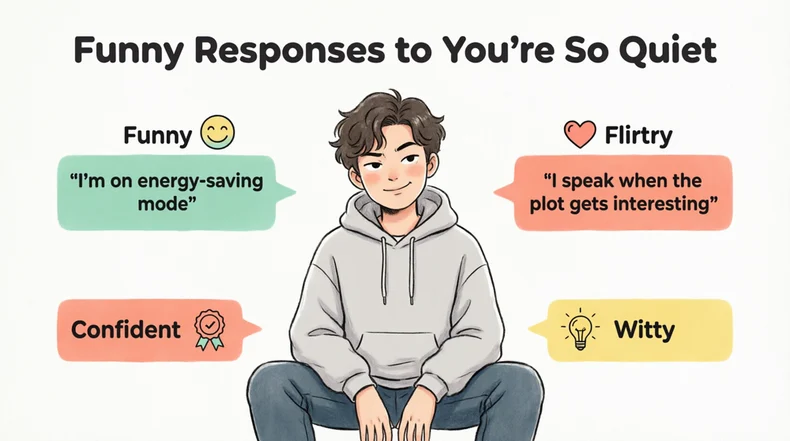
The best funny responses to you’re so quiet turn an awkward comment into a lighthearted moment. Whether you’re talking to friends, replying to a crush, or handling comments at work, the right comeback lets you express your personality without feeling pressured to talk more.
Ever been sitting peacefully with friends when someone suddenly says, “You’re so quiet”? Suddenly, everyone looks at you, and your brain decides this is the perfect time to forget every word you know. Whether you’re at a party, texting someone new, hanging out with friends, or sitting through a work meeting, that little comment can feel awkward, funny, or even slightly annoying. You don’t owe anyone a constant stream of conversation.
Sometimes you’re simply comfortable listening, observing, or enjoying the moment. That’s where funny responses to you’re so quiet come in handy. A clever comeback can break the tension, make people laugh, or confidently show that being quiet is part of your personality.
1. Funny Responses to You’re So Quiet
- I’m just on energy-saving mode.Example: Use it when friends notice you’ve barely spoken during a casual hangout.Meaning: You’re conserving energy instead of talking nonstop.
- I speak when the plot gets interesting.Example: Try it when a group conversation feels predictable.Meaning: You prefer meaningful or entertaining conversations.
- My words are on a coffee break.Example: Use it when someone comments on your silence over lunch.Meaning: You’re jokingly explaining your lack of conversation.
- I’m buffering. Give me a second.Example: Say it when someone expects an immediate response.Meaning: You need a little time before joining the conversation.
- I’m saving my best lines for later.Example: Use it when friends tease you for staying quiet at a party.Meaning: You’re playfully suggesting your best moments are still coming.
- Silence is my favorite podcast.Example: Try it when you’re enjoying a peaceful moment with friends.Meaning: You genuinely appreciate quiet time.
- I’m letting everyone else have their podcast episode.Example: Use it when one person has been talking for ages.Meaning: You’re humorously pointing out that others have dominated the conversation.
- My social battery is updating.Example: Say it when your energy starts fading during a gathering.Meaning: You need time to recharge socially.
- I’m the background music of this group.Example: Use it when you’re happy to listen rather than lead the conversation.Meaning: You’re comfortable playing a quieter role.
- I have a limited word subscription.Example: Try it when friends expect you to talk more.Meaning: You’re joking about being selective with your words.
- I’m observing the documentary.Example: Say it when everyone else is busy discussing the latest gossip.Meaning: You’re enjoying watching the situation unfold.
- Why waste words when I can make mysterious eye contact?Example: Use it with friends who know your quiet personality.Meaning: You’re turning your silence into a playful, mysterious quality.
2. Witty Responses to You’re So Quiet
- Not every thought needs a public announcement.Example: Use it when someone expects you to comment on everything.Meaning: You value thoughtful communication over constant talking.
- I’m listening. It’s a rare and valuable skill.Example: Try it when someone points out that you’re mostly listening.Meaning: You remind them that listening is also meaningful participation.
- I prefer quality over quantity, even with words.Example: Use it during a discussion about your reserved personality.Meaning: You prefer meaningful statements to unnecessary chatter.
- Someone has to keep the conversation balanced.Example: Say it when a talkative friend teases you.Meaning: You humorously present your silence as a useful contribution.
- My thoughts have a strict editing policy.Example: Try it when you take your time before responding.Meaning: You consider your words before saying them.
- I’m collecting information for my future autobiography.Example: Use it when people-watching at a social event.Meaning: You enjoy observing people and their behavior.
- I don’t compete in the talking Olympics.Example: Say it when everyone is speaking over one another.Meaning: You have no desire to win a conversation.
- I’m giving your ears a well-deserved vacation.Example: Try it when a friend jokes about your silence.Meaning: You’re playfully suggesting that silence can be refreshing.
- My words are carefully budgeted.Example: Use it when someone asks why you rarely speak unnecessarily.Meaning: You choose your words thoughtfully.
- I’m waiting for a conversation worth interrupting my thoughts for.Example: Say it when a discussion has not caught your attention yet.Meaning: You want something engaging to contribute to.
- I believe in speaking with purpose.Example: Use it in a discussion about communication styles.Meaning: You prefer intentional communication.
- I’m a full-time listener with occasional speaking hours.Example: Try it when meeting a group of talkative people.Meaning: You humorously embrace your listening-first personality.
3. Sarcastic Responses to You’re So Quiet
- Sorry, I forgot to submit my daily word quota.Example: Use it when a friend repeatedly points out your silence.Meaning: You’re sarcastically questioning the expectation that you must talk.
- Would you like a presentation on my silence?Example: Try it when someone makes an unnecessary observation.Meaning: You’re exaggerating the comment to highlight how unimportant it feels.
- Breaking news: Quiet person enjoys being quiet.Example: Use it when someone acts surprised by your personality.Meaning: You’re pointing out that your behavior should not be shocking.
- I’ll notify the press when I start talking.Example: Say it when a group makes a big deal out of your silence.Meaning: You’re joking about the attention your quietness receives.
- Thank you for that groundbreaking observation.Example: Try it when someone states the obvious.Meaning: You’re sarcastically acknowledging an unremarkable comment.
- Should I start talking just to keep you entertained?Example: Use it when someone pressures you to participate.Meaning: You refuse to make constant conversation your responsibility.
- And you’re very committed to pointing it out.Example: Say it when the same person keeps repeating the comment.Meaning: You’re highlighting their habit of commenting on your behavior.
- I’ll try being louder in the next episode.Example: Use it when someone jokes that your personality needs an update.Meaning: You’re treating your quietness like an ongoing show.
- My silence seems to be today’s main topic.Example: Try it when a group focuses too much on your quietness.Meaning: You’re pointing out the unnecessary attention.
- Don’t worry, the talking subscription isn’t canceled.Example: Use it when someone assumes you never talk.Meaning: You’re teasing them while leaving room for future conversation.
- I’m sorry my silence interrupted your commentary.Example: Say it when someone keeps narrating how little you speak.Meaning: You’re sarcastically turning their observation back on them.
- I’ll speak when my manager approves the statement.Example: Try it with friends who enjoy dry humor.Meaning: You’re joking that even your words require official approval.
4. Polite Responses to You’re So Quiet
- I’m more of a listener than a talker.Example: Use it when meeting new people at a social gathering.Meaning: You explain your communication style without sounding defensive.
- I just take a little time to warm up.Example: Try it when you’re around unfamiliar people.Meaning: You need time to feel comfortable before speaking freely.
- I’m enjoying listening to everyone.Example: Say it during a group discussion where others are sharing stories.Meaning: You’re showing that you are engaged even when quiet.
- I like to think before I speak.Example: Use it when someone politely asks about your reserved nature.Meaning: You value thoughtful responses.
- I’m comfortable with a little silence.Example: Try it when someone assumes the quiet means something is wrong.Meaning: You communicate that silence is perfectly fine with you.
- I open up more when I get to know people.Example: Use it when meeting new colleagues or acquaintances.Meaning: You explain that familiarity helps you feel more expressive.
- I’m having a good time, just quietly.Example: Say it when a host checks whether you’re enjoying an event.Meaning: You reassure them that you’re happy to be there.
- I enjoy taking everything in first.Example: Try it when joining a new group.Meaning: You prefer to observe before participating.
- That’s just my natural personality.Example: Use it when someone makes a gentle comment about your quietness.Meaning: You calmly acknowledge your temperament.
- I’m listening, so I’m still part of the conversation.Example: Say it when someone worries you’re feeling left out.Meaning: You clarify that listening is your way of participating.
- I speak more when a topic catches my interest.Example: Use it during a casual introduction.Meaning: You explain that your participation depends on the subject.
- Quiet moments are comfortable for me.Example: Try it when someone asks whether you’re feeling awkward.Meaning: You express your comfort with peaceful moments.
5. Confident Responses to You’re So Quiet
- Quiet is a personality, not a problem.Example: Use it when someone treats your silence like a weakness.Meaning: You confidently accept your personality.
- I don’t need to be the loudest person in the room.Example: Say it when someone compares your communication style with others.Meaning: You understand that confidence does not require constant talking.
- I know when to speak and when to listen.Example: Try it in a conversation about your reserved nature.Meaning: You show confidence in your communication choices.
- My presence doesn’t need a microphone.Example: Use it when someone suggests you need to be more noticeable.Meaning: You believe your value exists without constant attention.
- I let my actions speak for me.Example: Say it when someone assumes quiet people lack confidence.Meaning: You value behavior and results over empty words.
- I speak when I have something to say.Example: Try it when you’re being pressured to contribute unnecessarily.Meaning: You prefer purposeful communication.
- Being quiet doesn’t mean being unsure.Example: Use it when someone mistakes your silence for nervousness.Meaning: You separate your personality from your confidence level.
- I don’t perform for attention.Example: Say it when someone expects you to entertain a group.Meaning: You are comfortable without being the center of attention.
- My comfort matters more than your assumptions.Example: Try it when someone judges your quietness unfairly.Meaning: You prioritize your own comfort over other people’s expectations.
- I’m comfortable letting others take the spotlight.Example: Use it during group activities or social events.Meaning: You don’t need attention to feel secure.
- My voice is valuable, even when I use it less.Example: Say it when someone underestimates your contributions.Meaning: You recognize the worth of your perspective.
- I choose my moments, and I choose them well.Example: Try it when explaining why you don’t speak constantly.Meaning: You confidently control when and how you contribute.
6. Flirty Responses to You’re So Quiet
- Maybe you haven’t asked the right questions yet.Example: Use it when your crush notices your silence.Meaning: You’re inviting them to make the conversation more interesting.
- I’m waiting for you to make me blush.Example: Try it during a playful conversation with someone you like.Meaning: You’re giving them a charming opportunity to flirt.
- I get quieter around cute people.Example: Use it when a crush teases you about being reserved.Meaning: You’re hinting that their presence makes you nervous in a sweet way.
- I’m just trying not to say something embarrassing in front of you.Example: Say it when you feel shy around someone attractive.Meaning: You’re admitting that their presence affects you.
- Keep talking. I like your voice.Example: Try it during a relaxed conversation with your crush.Meaning: You’re showing interest while inviting them to continue.
- Maybe I’m waiting for you to steal the conversation.Example: Use it when someone you like notices your quietness.Meaning: You’re playfully giving them room to take the lead.
- I’m shy, but I can make an exception for you.Example: Say it when flirting with someone you’re getting closer to.Meaning: You’re suggesting they make you feel comfortable.
- You make me forget my best lines.Example: Try it when you feel nervous talking to your crush.Meaning: You’re revealing that they have a charming effect on you.
- I’m enjoying the view, actually.Example: Use it when someone attractive catches you quietly observing them.Meaning: You’re giving a subtle compliment.
- Give me a reason to start talking.Example: Say it when the flirting feels mutual and playful.Meaning: You’re inviting them to make the next move.
- I’m saving my sweetest words for you.Example: Try it when exchanging affectionate messages.Meaning: You’re suggesting they deserve special attention.
- I talk more when my heart feels comfortable.Example: Use it when a crush asks why you’re reserved.Meaning: You’re expressing that emotional comfort helps you open up.
7. Cute Responses to You’re So Quiet
- I’m a little mouse in a room full of cats.Example: Use it when meeting a lively group of friends.Meaning: You’re playfully describing yourself as shy and gentle.
- My words are taking a tiny nap.Example: Try it when you can’t think of anything to say.Meaning: You’re making your silence sound adorable.
- I’m just a soft-spoken little human.Example: Use it when someone comments on your gentle personality.Meaning: You affectionately embrace your quiet nature.
- I’m shy until the snacks arrive.Example: Say it at a party where food is being served.Meaning: You’re joking that food makes socializing easier.
- My social battery is a tiny bunny.Example: Try it when your energy fades during a gathering.Meaning: You describe your limited social energy in a cute way.
- I’m just here collecting happy little moments.Example: Use it during a peaceful outing with friends.Meaning: You enjoy the experience without needing to talk constantly.
- I have a quiet little world of my own.Example: Say it when someone asks what you’re thinking about.Meaning: You appreciate your imagination and inner world.
- I’m waiting for my words to wake up.Example: Try it when you’re feeling sleepy or shy.Meaning: You’re playfully explaining your lack of conversation.
- I come with a gentle volume setting.Example: Use it when someone notices your soft-spoken voice.Meaning: You describe your naturally quiet manner.
- I’m a listener with a sprinkle of shyness.Example: Say it when introducing yourself to new friends.Meaning: You combine attentiveness with a little bashfulness.
- My personality blooms after a little sunshine.Example: Try it when meeting people for the first time.Meaning: You need warmth and familiarity to open up.
- I’m quiet now, but wait until I get comfortable.Example: Use it when someone assumes you’re always reserved.Meaning: You suggest that your playful side appears with familiarity.
8. Brutal but Respectful Responses to You’re So Quiet
- And yet you keep talking about it.Example: Use it when someone repeatedly comments on your silence.Meaning: You point out that their attention to your quietness is unnecessary.
- My silence shouldn’t bother you this much.Example: Try it when someone seems determined to make you speak.Meaning: You set a clear boundary around your personality.
- I didn’t realize talking was compulsory.Example: Say it when a group pressures you to join every discussion.Meaning: You challenge the expectation that everyone must speak constantly.
- You don’t have to fill every silence.Example: Use it when someone seems uncomfortable with a quiet moment.Meaning: You remind them that silence doesn’t always need fixing.
- I’m quiet, not available for personality reviews.Example: Try it when someone starts evaluating your behavior.Meaning: You decline unwanted judgments about your personality.
- My silence isn’t an invitation for criticism.Example: Say it when a comment becomes personal or insulting.Meaning: You establish a boundary against unnecessary criticism.
- You can let me exist without a commentary track.Example: Use it when someone narrates your behavior repeatedly.Meaning: You ask for space without apologizing for who you are.
- Not everyone has to communicate the way you do.Example: Try it when someone compares your personality with theirs.Meaning: You defend different communication styles.
- I’m not responsible for making every moment entertaining.Example: Say it when others expect you to keep a conversation going.Meaning: You reject the pressure to entertain everyone.
- My quietness isn’t a group project.Example: Use it when several people try to get you to talk.Meaning: You make it clear that your personality is not everyone’s business.
- You can ask a question instead of making an observation.Example: Try it when someone keeps pointing out your silence.Meaning: You encourage more thoughtful and respectful communication.
- I’ll speak when I feel like it, and that’s enough.Example: Say it when someone refuses to respect your boundaries.Meaning: You confidently assert your right to choose when to speak.
9. Creative Responses to You’re So Quiet
- I’m a library with a few books still unpublished.Example: Use it when someone wants to know more about you.Meaning: You have plenty of thoughts and stories that you don’t share immediately.
- My personality has a slow-release feature.Example: Try it when joining a new social group.Meaning: Your personality becomes more visible over time.
- I’m running a silent film festival in my head.Example: Say it when your imagination is more entertaining than the conversation.Meaning: You’re amusingly describing your busy inner world.
- My thoughts are backstage preparing for the show.Example: Use it when you need time before contributing.Meaning: You have ideas but aren’t ready to share them yet.
- I’m a plot twist with a mute button.Example: Try it when friends expect you to be more expressive.Meaning: You describe yourself as interesting but occasionally quiet.
- I’m a limited-edition conversation starter.Example: Say it when someone jokes about your reserved nature.Meaning: You playfully present your words as something special.
- My inner narrator is doing all the talking.Example: Use it when you’re lost in thought during a gathering.Meaning: Your mind is active even when you aren’t speaking aloud.
- I’m a calm ocean with a few hidden waves.Example: Try it when describing your personality to someone new.Meaning: Your quiet exterior can hide strong emotions and ideas.
- I’m in director’s mode, watching the scene unfold.Example: Say it when everyone else is busy leading the conversation.Meaning: You prefer observing before participating.
- My words are waiting for their grand entrance.Example: Use it when you’re slowly getting comfortable with a group.Meaning: You’re suggesting your contribution will come at the right moment.
- I’m a mystery novel with the pages turned slowly.Example: Try it when someone says you’re difficult to figure out.Meaning: You reveal yourself gradually rather than all at once.
- I’m running a thought laboratory.Example: Say it when you’re quietly thinking through an interesting topic.Meaning: You enjoy analyzing ideas before sharing them.
10. Chill and Casual Responses to You’re So Quiet
- Yeah, I’m just chilling.Example: Use it when friends notice you’re relaxed and quiet.Meaning: You’re comfortable and have no urgent need to speak.
- Nothing much, just listening.Example: Try it during a casual group conversation.Meaning: You’re present and following along.
- I’m good, just enjoying the vibe.Example: Say it when someone checks whether you’re having fun.Meaning: You reassure them that you’re enjoying yourself.
- I’m in a low-key mood today.Example: Use it when you’re feeling less talkative than usual.Meaning: You explain your current mood without making it a big deal.
- Just taking it all in.Example: Try it at a party or during a group outing.Meaning: You’re observing and enjoying the experience.
- I’m letting the conversation flow.Example: Say it when everyone else is sharing stories.Meaning: You’re happy to participate without forcing your way in.
- All good, just enjoying some peace.Example: Use it during a quiet afternoon with friends.Meaning: You value the calm atmosphere.
- I’m on my relaxed setting.Example: Try it when you’re feeling comfortable and unbothered.Meaning: You’re choosing a laid-back approach to socializing.
- I’m here for the vibes, not the volume.Example: Say it when a gathering gets loud.Meaning: You enjoy the atmosphere without needing to be loud yourself.
- Just letting everyone else cook.Example: Use it when friends are carrying an entertaining conversation.Meaning: You’re happy to let others take the lead.
- I’m having a quiet kind of day.Example: Try it when someone notices you aren’t as talkative as usual.Meaning: You describe your mood honestly and casually.
- No big story, I’m just enjoying the moment.Example: Say it when someone assumes your silence means something is wrong.Meaning: You show that there’s no hidden problem behind your quietness.
11. Professional Responses to You’re So Quiet
- I prefer to listen carefully before contributing.Example: Use it during a workplace meeting when a colleague comments on your silence.Meaning: You present listening as an intentional professional habit.
- I’m processing the discussion before sharing my thoughts.Example: Try it when a team is brainstorming new ideas.Meaning: You explain that you need time to form a useful response.
- I tend to speak when I can add value.Example: Say it when discussing your participation in team meetings.Meaning: You prioritize relevant contributions.
- I’m following along and taking everything into consideration.Example: Use it when a manager checks your engagement.Meaning: You reassure them that you’re paying attention.
- I appreciate hearing different perspectives first.Example: Try it during a collaborative discussion.Meaning: You value listening to colleagues before offering your opinion.
- I usually organize my thoughts before speaking.Example: Say it when explaining your communication style to a coworker.Meaning: You emphasize preparation and clarity.
- I’m comfortable contributing when the topic requires my input.Example: Use it when discussing your role on a team.Meaning: You clarify that your participation is purposeful.
- I’m focused on understanding the key points.Example: Try it during a detailed project briefing.Meaning: You explain that concentration is your current priority.
- I may be quiet, but I’m actively engaged.Example: Say it when someone mistakes your reserved manner for disinterest.Meaning: You distinguish quietness from a lack of involvement.
- I like to make sure my comments are constructive.Example: Use it when a colleague asks why you rarely interrupt.Meaning: You emphasize thoughtful and helpful communication.
- I’m taking a moment to evaluate the options.Example: Try it when a team is making a decision.Meaning: You show that you’re thinking carefully before responding.
- I’ll share my perspective when I’ve considered the details.Example: Say it when you need additional time before offering feedback.Meaning: You demonstrate a measured and professional approach.
12. Emotional Responses to You’re So Quiet
- Sometimes my thoughts are louder than my words.Example: Use it when someone you trust asks why you’re quiet.Meaning: You explain that your inner world can be emotionally busy.
- I’m processing more than I’m saying.Example: Try it when you’re reflecting on a personal situation.Meaning: You have feelings or thoughts that need time to settle.
- Not every feeling comes with an explanation.Example: Say it when you aren’t ready to discuss your emotions.Meaning: You acknowledge that some feelings are difficult to express.
- I feel things deeply, even when I don’t say much.Example: Use it during an honest conversation with a close friend.Meaning: You communicate emotional depth without needing many words.
- Sometimes silence helps me understand myself.Example: Try it when you’re taking time to reflect.Meaning: You see quiet moments as a way to process your emotions.
- I’m not distant; I’m just gathering my thoughts.Example: Say it when someone worries that you’re withdrawing.Meaning: You reassure them that you need a little time.
- I open up when I feel safe enough to be honest.Example: Use it when someone asks why you rarely share personal details.Meaning: You value trust and emotional security.
- My quiet moments mean more than they show.Example: Try it when discussing your personality with someone close.Meaning: You recognize the meaning behind your private reflections.
- I’m learning how to express what I feel.Example: Say it when you’re working through a difficult emotion.Meaning: You acknowledge that expressing feelings can take practice.
- Sometimes I need understanding more than questions.Example: Use it when a friend keeps asking you to explain your silence.Meaning: You gently express a need for patience and empathy.
- I’m quiet because I’m listening to myself, too.Example: Try it during a period of personal reflection.Meaning: You are paying attention to your own needs and feelings.
- I’ll share when I’m ready, and I appreciate your patience.Example: Say it when someone genuinely wants to understand you.Meaning: You invite support while keeping control over your boundaries.
13. Sweet Responses to You’re So Quiet
- I’m happy just being here with you.Example: Use it when a friend worries you’re not enjoying their company.Meaning: You show appreciation for their presence.
- I don’t need many words to enjoy good company.Example: Try it when spending time with people you feel comfortable around.Meaning: You value connection beyond conversation.
- I’m listening because what you say matters to me.Example: Say it when someone you care about notices your silence.Meaning: You show that your quietness comes with genuine attention.
- Sometimes the best moments don’t need words.Example: Use it during a peaceful moment with a close friend or partner.Meaning: You appreciate comfortable silence.
- I’m just enjoying having you around.Example: Try it when someone asks whether you’re bored.Meaning: You reassure them that their company is enough.
- My quiet side feels safe around good people.Example: Say it when discussing what makes you comfortable socially.Meaning: You associate emotional ease with trusted company.
- I may not say much, but I care a lot.Example: Use it when someone mistakes your reserved nature for indifference.Meaning: You express affection without relying on constant words.
- I’m listening to every little detail.Example: Try it when a loved one is sharing a story.Meaning: You show that their words have your attention.
- Good company makes silence feel beautiful.Example: Say it during a relaxed outing with someone special.Meaning: You appreciate peaceful connection.
- I’m saving my energy for the people who feel like home.Example: Use it when explaining why you feel more expressive around close friends.Meaning: You reserve your emotional energy for trusted relationships.
- I feel comfortable enough not to fill every pause.Example: Try it when spending quiet time with a partner.Meaning: You express trust and ease in the relationship.
- You don’t have to worry; I’m enjoying this moment with you.Example: Say it when someone close thinks your silence signals unhappiness.Meaning: You reassure them with warmth and honesty.
14. Clever Responses to You’re So Quiet
- I have a lot to say, just not about everything.Example: Use it when someone assumes you have nothing to contribute.Meaning: You distinguish having thoughts from sharing every thought.
- My listening skills are getting a workout.Example: Try it during a lively group discussion.Meaning: You humorously frame listening as an active skill.
- I let silence do some of the heavy lifting.Example: Say it when a conversation doesn’t need constant commentary.Meaning: You recognize that silence can communicate comfort or thoughtfulness.
- I don’t confuse noise with connection.Example: Use it when someone equates talking more with socializing better.Meaning: You value meaningful interaction over sheer volume.
- I’m thinking in paragraphs and speaking in headlines.Example: Try it when your thoughts are more detailed than your spoken replies.Meaning: You humorously describe your concise communication style.
- I don’t interrupt my brain just to entertain the room.Example: Say it when someone expects you to keep the conversation going.Meaning: You prefer thinking naturally instead of performing for others.
- My words have a purpose-built release schedule.Example: Use it when you wait for the right moment to speak.Meaning: You choose the timing of your contributions.
- I’m gathering data before making a statement.Example: Try it when meeting unfamiliar people.Meaning: You like understanding a situation before responding.
- I believe in thoughtful pauses and well-timed sentences.Example: Say it when someone asks why you take your time speaking.Meaning: You value clarity and timing.
- I’m not quiet; I’m selectively audible.Example: Use it when joking with friends who know your personality.Meaning: You playfully suggest that you speak when you choose.
- My brain doesn’t need a microphone to stay active.Example: Try it when you’re quietly thinking through a conversation.Meaning: You point out that silence doesn’t mean an inactive mind.
- I’m proof that a conversation has a listening side, too.Example: Say it when everyone focuses on who talks the most.Meaning: You remind others that communication requires listening as well as speaking.
15. Short and Sassy Responses to You’re So Quiet
- And peaceful, too.Example: Use it when someone comments on your calm personality.Meaning: You turn the observation into a positive quality.
- That’s the charm.Example: Try it when a friend playfully teases you.Meaning: You confidently own your reserved nature.
- Less noise, more peace.Example: Say it when you’re enjoying a calm environment.Meaning: You prefer tranquility over unnecessary chatter.
- Quietly thriving.Example: Use it as a quick response in a casual conversation.Meaning: You show that you’re doing well without needing attention.
- Mystery suits me.Example: Try it when someone calls you difficult to read.Meaning: You embrace being a little mysterious.
- I talk on a need-to-speak basis.Example: Say it when a friend expects commentary on everything.Meaning: You communicate selectively and confidently.
- That’s my default setting.Example: Use it when someone notices your naturally quiet personality.Meaning: You explain your temperament without overthinking it.
- Calm is my brand.Example: Try it when describing your laid-back personality.Meaning: You present your peaceful nature as part of your identity.
- I let the results talk.Example: Say it when someone questions your quiet confidence.Meaning: You value actions more than words.
- Quiet, not clueless.Example: Use it when someone wrongly assumes you haven’t noticed something.Meaning: You remind them that silence doesn’t mean a lack of awareness.
- Soft voice, strong opinions.Example: Try it when someone mistakes your quietness for agreement.Meaning: You show that a gentle manner can coexist with firm beliefs.
- My silence has excellent taste.Example: Say it when friends are joking around about your personality.Meaning: You use playful confidence to own your quiet side.
Frequently Asked Questions
What Does “You’re So Quiet” Mean?
It usually means someone has noticed that you aren’t talking much during a conversation or social gathering.
Is “You’re So Quiet” Ever Flirty?
Yes, it can be a playful way to start a conversation or encourage someone shy to open up.
How Should I Respond Professionally to “You’re So Quiet”?
Say, “I prefer to listen carefully before contributing.” It sounds thoughtful and professional.
What If I Don’t Mean to Be Quiet?
Explain naturally: “I’m just thinking today, but I’m happy to be here.”
Is Humor Appropriate When Someone Says “You’re So Quiet”?
Yes, if the situation feels friendly. Choose a light joke that suits your relationship.
Why Do People Say “You’re So Quiet”?
They may be curious, making conversation, teasing you, or noticing a difference in communication styles.
What Is a Good Comeback for “You’re So Quiet”?
Try, “I speak when the plot gets interesting.” It’s playful, memorable, and easy to deliver.
How Do I Respond Without Sounding Rude?
Say, “I’m more of a listener, but I’m enjoying the conversation.” It keeps things friendly.
How Do I Respond When My Crush Says “You’re So Quiet”?
Try, “Maybe you haven’t asked the right questions yet.” It’s light, flirty, and inviting.
What If Someone Keeps Commenting on My Silence?
Calmly say, “That’s just my personality, and I’m comfortable with it.” Set a respectful boundary.
Conclusion
Being told “you’re so quiet” doesn’t have to turn a comfortable moment into an awkward one. The right response can make people laugh, show your confidence, or help someone understand your personality a little better. Whether you prefer witty comebacks, flirty lines, polite explanations, or short and sassy replies, choose the words that feel natural to you.
Sometimes a thoughtful response says more than a long speech. Try different replies with friends, your crush, or colleagues, and see which ones fit your style. Save your favorites, share them with your quiet friends, and keep being yourself. Your voice matters, even when you don’t use it constantly!